What Is a Book Portfolio? (And Why Professionals Are Building One)
A book portfolio is a collection of Amazon KDP books built as a compounding income asset — not a creative project. Here's what it is, how it works, and why professionals are building them.
A book portfolio is a collection of non-fiction books published on Amazon's Kindle Direct Publishing platform, built systematically as an income asset rather than as a creative project. Each title generates royalties independently — and as books are added in validated niches, those royalties compound month after month without requiring proportional increases in time or effort.
If you've never heard of this before, that's not an accident. Most people who encounter self-publishing think of it as something writers do — a creative endeavor with uncertain commercial outcomes. A book portfolio is something structurally different. It's closer to a property portfolio or a dividend stock portfolio than to a literary career. The books are the assets. Amazon is the distribution engine. The royalties are the income stream. The portfolio is the business.
This is not yet a mainstream income model. The people building book portfolios today are ahead of a market that is still catching up to what's possible on this platform in 2026.
Quick answer: A book portfolio is a structured collection of Amazon KDP books designed to generate compounding residual income — not a creative project. Publishers build portfolios of 3 to 12 titles in validated niches, each earning royalties independently while cross-promoting the others. The $23/day-per-book benchmark means a 6-book portfolio targets roughly $4,140/month in royalties at maturity.
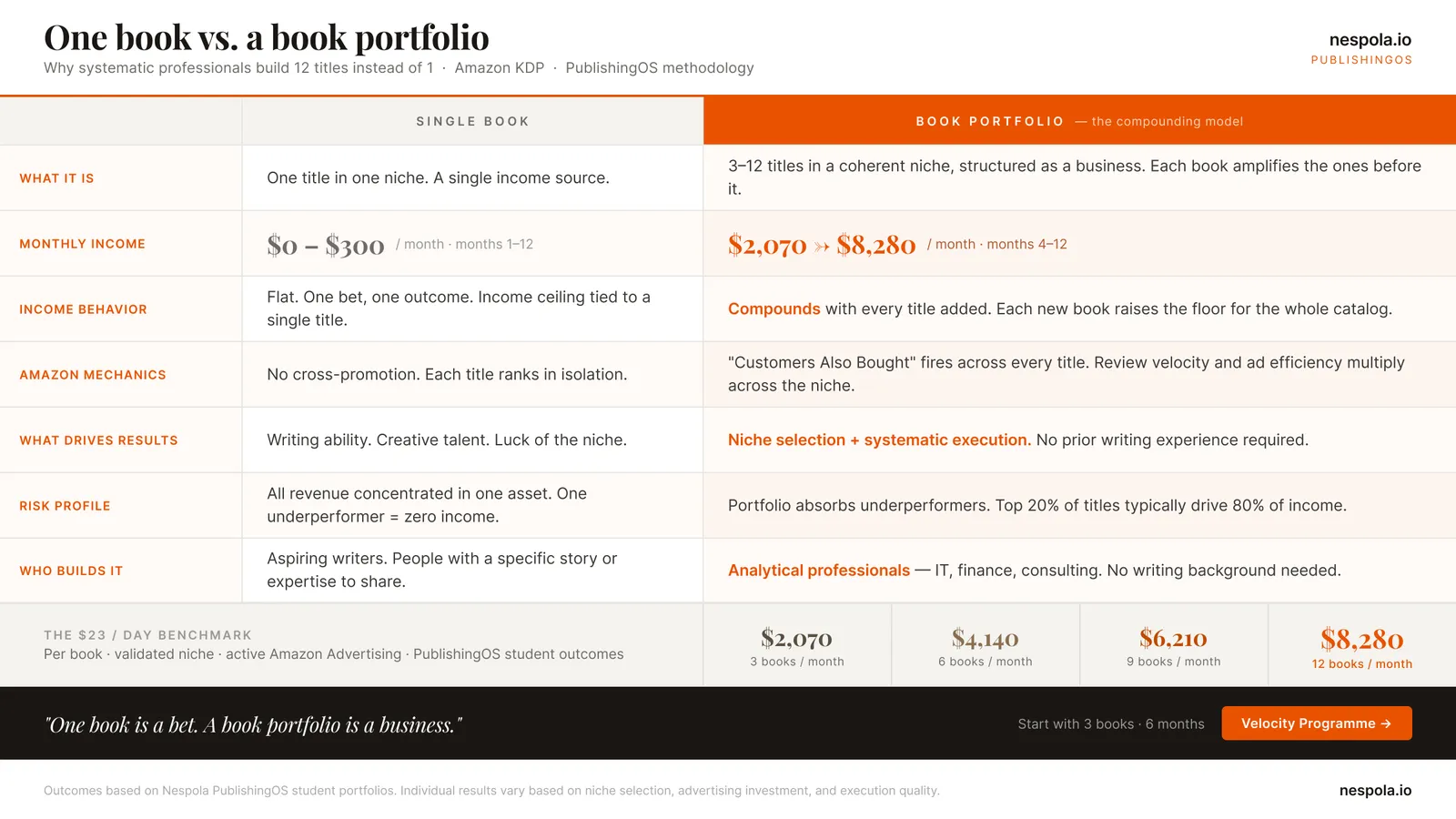
What a book portfolio actually is
A book portfolio is not a collection of books you've written because you had something to say. It is not a side project for aspiring authors. It is not a creative outlet that occasionally earns money.
A book portfolio is a structured collection of non-fiction titles in validated niches, published on Amazon KDP, where each title is:
- Designed to earn a predictable daily royalty across multiple formats
- Selected using search data — not instinct — to confirm that real readers are actively buying in that category
- Part of a coherent niche system where book 2 and book 3 benefit from the audience that book 1 built
The distinction matters because it changes who this is for. Book portfolios are not built by writers. They are built by systematic thinkers — people who approach income generation the way an analyst approaches a problem: identify a validated market, build the product to specification, deploy it on the world's largest book marketplace, and measure the results.
The majority of successful portfolio publishers Nespola works with have no prior writing or publishing experience. What they have is an analytical mindset, a willingness to follow a process, and the patience to let a compounding model run for 6 to 12 months before it produces full-time equivalent income.
How a book portfolio generates income
Amazon KDP pays publishers royalties every month — automatically, from every sale. There are no invoices to send, no clients to manage, no service to deliver after the book is published. Once the asset exists, it generates income.
For non-fiction, the royalty structure works like this:
Ebooks priced between $2.99 and $9.99 earn a 70% royalty. A $6.99 ebook earns approximately $4.89 per sale.
Paperbacks earn 60% of the list price minus the printing cost. A $14.99 paperback with a $3.50 print cost earns approximately $5.49 per sale.
Hardcovers carry higher margins still. A $22.99 hardcover with a $7.00 print cost nets approximately $6.79 per sale.
Each format is an independent revenue stream from the same content. The book is created once. It is published across three formats. Amazon Advertising drives consistent, targetable traffic to each listing. Royalties arrive monthly — whether or not you worked that month.
This is why the model compounds. Each new title adds a new income stream on top of the ones already running. Each new book in the same niche activates Amazon's cross-promotional mechanics — the "Customers Also Bought" placements that surface your other titles to readers who just bought one. The more coherent the portfolio, the more those mechanics amplify every title's performance.
The $23/day benchmark
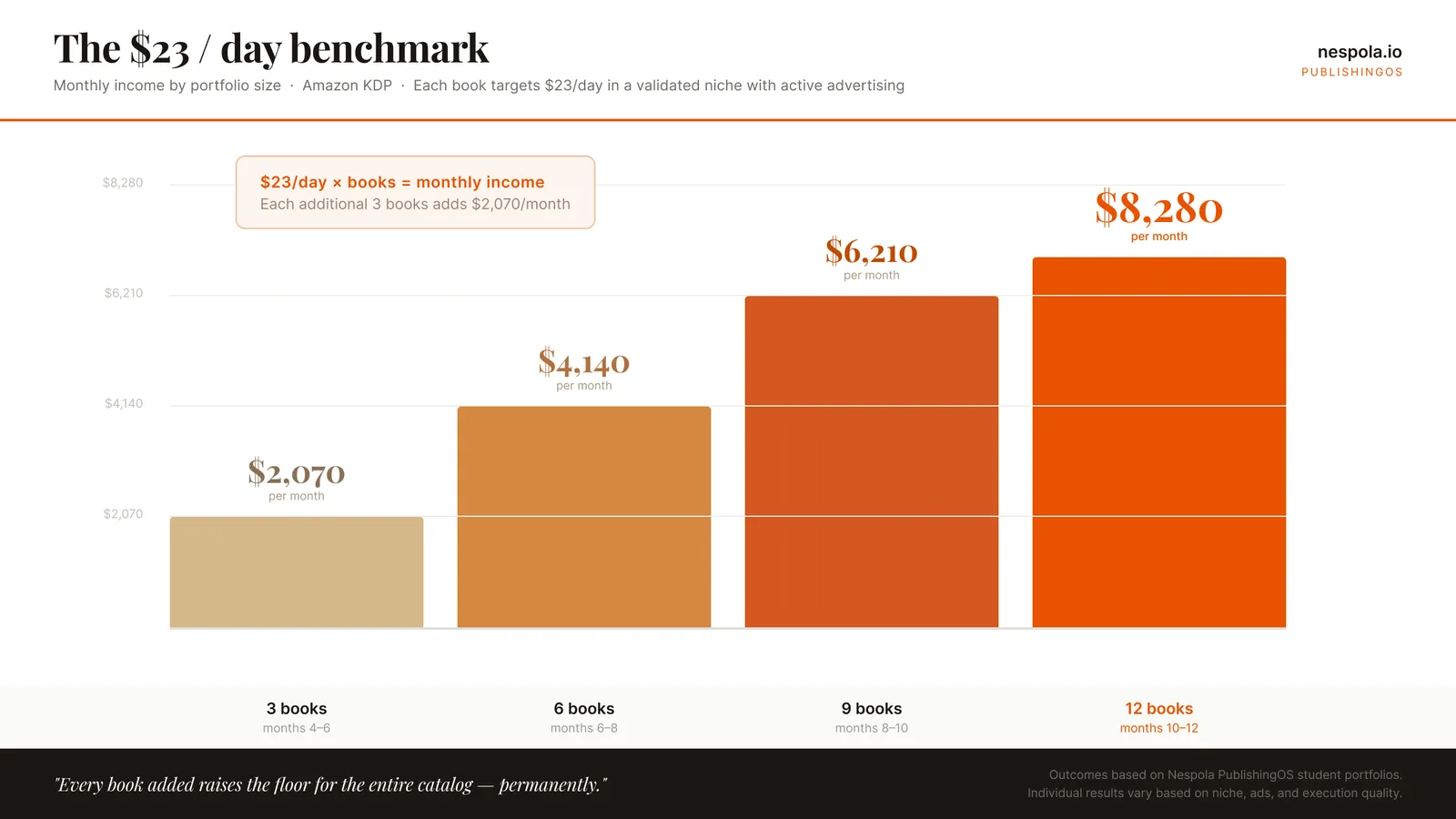
At Nespola, we use one number to explain the model: $23/day per book.
A book in a validated niche, with a professional cover, keyword-optimized listing, and active Amazon Advertising, targets approximately $23/day ($690/month) in combined royalties across formats. That is the per-book target for a systematically built portfolio — not a guaranteed outcome, but what disciplined execution in a validated niche makes achievable.
The portfolio arithmetic from there is straightforward:
| Portfolio size | Daily target | Monthly income | Typical timeline |
|---|---|---|---|
| 3 books (MVBP) | $69/day | ~$2,070/month | Months 4–6 |
| 6 books | $138/day | ~$4,140/month | Months 6–8 |
| 9 books | $207/day | ~$6,210/month | Months 8–10 |
| 12 books | $276/day | ~$8,280/month | Months 10–12 |
Based on Nespola PublishingOS student portfolio outcomes. Individual results vary based on niche selection, production quality, advertising investment, and execution consistency.
Who builds book portfolios?
The professionals building book portfolios today are not writers. They are IT managers and engineers who apply data discipline to niche selection. Finance professionals who evaluate book portfolios the way they evaluate investment instruments. Business owners who want a scalable income asset that does not require trading more time for more money. Employed professionals in any field looking for a systematic path to income that does not depend on freelancing, social media, or physical inventory.
The skills that predict success in book portfolio building are analytical, not creative:
- Systematic thinking — following a validated publishing framework consistently, rather than improvising with each new book.
- Comfort with data — reading Best Sellers Rank data, interpreting Amazon Advertising metrics, and making niche decisions based on search volume rather than personal interest.
- Project management — coordinating cover design, manuscript production, listing optimization, and launch sequencing across multiple simultaneous titles.
- Tolerance for a compounding ramp — understanding that months 1 and 2 are infrastructure, not income, and that the return arrives in months 6 through 12.
Writers, paradoxically, often find this harder than analysts. The impulse to write something personally meaningful competes with the portfolio discipline of writing something the market data confirms readers will pay for. Professionals who have no emotional attachment to being "an author" make the strategic decisions faster and more consistently.
James Allwinton spent eight years at an investment bank before building a KDP portfolio that now generates $300,000+/year — working four hours a month. "Investment banking taught me to spot leverage," he says, "and publishing, done right, is the purest form of it." Melanie Sterling, a former medical technologist with no publishing background, built a 26-book portfolio generating $6,000/month while raising three sons as a single parent. Neither arrived as a writer. Both arrived as someone who recognized a system worth executing.
How it compares to other income models
If you are evaluating a book portfolio as an income model, you are likely also considering alternatives. Here is an honest comparison:
| Model | Time to $1k/month | Scales without more time? | Upfront capital | Income type |
|---|---|---|---|---|
| Book portfolio (KDP) | 4–8 months | Yes — each book adds to the floor | Low ($0–$2,000) | Residual royalties |
| Freelancing / consulting | 2–6 weeks | No — stops when you stop | None | Time-for-money |
| Amazon FBA | 6–18 months | Partially — inventory-constrained | High ($5,000–$20,000+) | Product margin |
| YouTube channel | 12–36 months | Yes — algorithm-dependent | Low–Medium | Ad revenue |
| Online courses | 6–12 months | Partially — needs active launches | Low–Medium | Digital product |
| Dividend investing | Years | Yes — fully passive at scale | Very high ($100,000+) | Passive (dividends) |
The book portfolio model occupies a specific position: faster to meaningful income than most asset-building models, lower capital requirement than FBA or investing, and genuinely scalable in a way that service income is not. The trade-off is the 4–12-month ramp before significant royalties arrive, which is why the discipline of the first 90 days determines everything.
Why a portfolio compound differently than a single book
Publishing one book is a bet. Publishing three books in the same niche is the beginning of a system.
A single book has one sales channel, one format, and one chance to establish rank. A three-book portfolio in the same niche does something structurally different.
- It activates cross-promotional mechanics. When a reader buys Book 1, Amazon's algorithm surfaces Books 2 and 3 in the "Customers Also Bought" placement. You do not pay for that. It is driven by the fact that the same reader profile buys all three titles — and Amazon's commercial incentive is to show them every relevant option.
- It builds review velocity across the whole catalog. Reviews accumulate across all three titles simultaneously. The aggregate social proof raises the conversion rate of every title in the niche.
- It validates the niche before you scale. Three books generate enough data to confirm that real buyers are active in this niche and that your specific approach to covering it works. From there, you scale to 6 and 12 books with evidence, not assumptions.
This three-book structure is what Nespola calls the Minimum Viable Book Portfolio — the smallest portfolio that can generate meaningful income, prove the model, and produce the cross-promotional dynamics that a single title cannot.
How to start: the 3-book proof of concept
The starting point is simpler than most people expect: three books, one niche, six months.
- Book 1 validates the niche. You select a category using search data, confirm that buyers are active and competition is manageable, commission a professional cover, publish across formats, and run Amazon Advertising from day one.
- Book 2 compounds the niche. Same reader, adjacent topic. Your first book's buyers are the natural audience for Book 2. The cross-promotional mechanics begin.
- Book 3 completes the Minimum Viable Book Portfolio. You now have three independent income streams in a validated niche, a cross-promotional flywheel running, and real data confirming which direction to scale.
This is the structure of the Nespola Velocity program — a six-month guided process for building your first three books with a Publisher Success Manager overseeing every decision from niche selection through cover design, listing optimization, and Amazon Advertising setup.
The goal of Velocity is not to make you a publisher. It is to answer one question with evidence: does this model work for you, in your niche, at your pace? After six months and three books, you have an answer built on data rather than assumptions — and a compounding income asset that either confirms the path forward or gives you the information to adjust it.
Frequently Asked Questions
- What is a book portfolio? A book portfolio is a collection of non-fiction books published on Amazon KDP, built systematically as an income-generating asset. Unlike traditional authorship, a book portfolio is designed around validated market demand — each title selected using search data, produced to professional standards, and structured to compound in income alongside the titles next to it. The goal is residual royalty income, not creative expression.
- Do you need to be a writer to build a book portfolio? No. The majority of successful portfolio publishers have no prior writing experience. The skills that matter are analytical thinking, process orientation, and patience with a compounding system — not creative writing ability. Many publishers work with editors or writing professionals to produce content, while focusing their own time on niche strategy, advertising, and portfolio decisions.
- How long does it take for a book portfolio to generate income? Most publishers earn $0–$300/month in months 1–4 while first books are building reviews and advertising is optimising. With 3–6 books and active advertising, $1,000–$2,000/month is a realistic 4–8 month target. Full-time-equivalent income ($5,000–$10,000+/month) typically requires 6–12 books and 8–12 months of consistent execution.
- How much does it cost to start a book portfolio? The primary upfront costs are professional cover design ($150–$400 per title) and Amazon Advertising spend during the launch phase ($200–$500/month per title while ads optimise). Total first-year investment for a 3-book portfolio typically runs $1,000–$2,500 in production costs plus advertising. Amazon KDP itself is free to publish on.
- What is the difference between a book portfolio and just self-publishing? Self-publishing typically refers to publishing individual books as standalone projects — often creatively driven, without a systematic niche strategy or cross-promotional architecture. A book portfolio is a business structure: books are income assets deployed in validated niches, designed to compound with each other, and managed with performance metrics, advertising budgets, and scale-up decision criteria.
- What is the Velocity programme? Velocity is Nespola's six-month programme for building your first Minimum Viable Book Portfolio — 3 books in one validated niche, published with professional production standards and active Amazon Advertising infrastructure. A Publisher Success Manager guides every decision from niche selection through each book's launch. The goal is to test the book portfolio model with real books and real data, in six months. Not sure if Velocity is right for you? Compare Velocity and Accelerator to find the right starting point.
Ready to build your first book portfolio? The Velocity programme takes you from zero publishing experience to 3 live books in 6 months — with a Publisher Success Manager guiding every decision. Explore Velocity →
Social Media Posts — What Is a Book Portfolio?
Social Media Posts
Article: What Is a Book Portfolio? (And Why Professionals Are Building One)
Published: May 14, 2026
URL: https://nespola.io/blog/what-is-a-book-portfolio
Account: Nespola company accounts (not Tommi personal)
X (Twitter)
Variant A — Single-insight standalone (seed post)
Post 24–48 hrs before the thread. No link. No hashtags. Just the claim.
Writers build books.
Professionals build catalogs.
Alternative seed line:
A book portfolio is not a publishing strategy. It is an asset allocation strategy.
Variant B — Data thread (main post)
Post as a thread. Link to article goes in the first reply — not in the main thread — to protect organic reach.
1/
A book portfolio is not a publishing strategy.
It is an asset allocation strategy.
2/
Here is what the math looks like:
3 books: $2,070/month (months 4–6)
6 books: $4,140/month (months 6–8)
9 books: $6,210/month (months 8–10)
12 books: $8,280/month (months 10–12)
One number drives all of it: $23/day per book.
3/
Why it compounds rather than flattening:
When a reader buys Book 1, Amazon surfaces Books 2 and 3 in "Customers Also Bought." No additional ad spend. Review velocity builds across every title. Ad efficiency improves with each book added.
4/
What drives results is not writing ability.
It is niche selection. Comfort with data. The patience to let a compounding model run for 6 to 12 months before it produces meaningful income.
5/
The professionals building book portfolios are not writers.
IT managers. Finance professionals. Consultants. People who approach income generation the way an analyst approaches a problem: validate the niche, build to spec, measure the results.
6/
James Allwinton spent 8 years in investment banking before building a KDP portfolio generating $300,000+ per year.
He works 4 hours a month on it.
"Publishing, done right, is the purest form of leverage."
7/
We published a full breakdown: what a book portfolio is, how the income model works, who is building one, and how to start.
Link in first reply.
First reply text:
https://nespola.io/blog/what-is-a-book-portfolio
Variant C — Reframe thread (alternate)
Shorter. Works better if Variant B was already posted on a previous article. Rotate format.
1/
Writers build books.
Professionals build catalogs.
2/
A writer's goal is the finished manuscript.
A professional's goal is a validated niche with 12 titles earning $690/month each.
3/
A writer thinks about story.
A professional thinks about Amazon's recommendation algorithm.
4/
A writer measures success by sales rank.
A professional measures it by monthly catalog income.
5/
Writing ability does not predict portfolio performance.
Niche selection does. Systematic execution does.
6/
We published a breakdown of what the portfolio model actually is.
Link in first reply.
First reply text:
https://nespola.io/blog/what-is-a-book-portfolio
Hook is the first line — this is what shows before "See more." Link goes in the comments, not the post body. No hashtags in body copy.
The reason most self-published books earn nothing is not the writing.
It is the structure.
One book is one income source. If the niche is wrong, the cover underperforms, or the timing is off, income is flat. No recovery mechanism. No compounding.
A book portfolio is different.
3 to 12 titles in one validated niche, each amplifying the others. When a reader buys the first book, Amazon surfaces the rest in "Customers Also Bought" -- no additional ad spend required. Review velocity builds across every title. Ad efficiency improves with each book added.
The math from our student portfolio data:
3 books: $2,070/month
6 books: $4,140/month
12 books: $8,280/month
The benchmark is $23/day per book in a validated niche with professional production and active Amazon Advertising.
The professionals building these portfolios are not writers. They are IT managers, finance professionals, consultants, and business owners who apply the same analytical skills they use at work to an asset that compounds while they sleep.
James Allwinton spent 8 years in investment banking before building a KDP portfolio generating $300,000+ per year. He works 4 hours a month on it.
We published a full breakdown of what a book portfolio actually is -- how the income model works, how Amazon's mechanics compound it, and what the path from 0 to 12 books looks like.
Link in the comments.
Comment text:
https://nespola.io/blog/what-is-a-book-portfolio
YouTube Community Post
Attach Image 2 (the $23/day bar chart) as the visual. Keep it short and direct. Drive comments.
Most people think self-publishing requires a creative writing background.
Here is what our student portfolio data actually shows:
3 books in one niche: $2,070/month
6 books: $4,140/month
12 books: $8,280/month
The benchmark is $23/day per book -- validated niche, professional cover, active Amazon Advertising.
The professionals building these portfolios are not authors. They are engineers, IT managers, finance workers, and consultants. People who think in systems rather than stories.
We published a full breakdown of the book portfolio model -- what it is, how the income stacks, and who is building one in 2026.
https://nespola.io/blog/what-is-a-book-portfolio
Are you exploring Amazon KDP as an income stream? Drop a comment -- we read every one.
First line is the hook -- visible before the "more" cutoff. Hashtags go at the very bottom.
The difference between 1 book and 12 books is not 12 times the work.
It is a completely different income model.
One book is a single bet. One niche, one cover, one shot. If the timing is off or the niche is wrong, income is flat. No compounding. No recovery mechanism.
A book portfolio is different.
3 to 12 titles in one niche, each amplifying the others through Amazon's recommendation engine, shared review velocity, and cumulative ad efficiency.
The math:
3 books = $2,070/month
6 books = $4,140/month
12 books = $8,280/month
The benchmark: $23/day per book in a validated niche.
The professionals building these portfolios are not writers. They are IT managers, finance professionals, and business owners applying analytical skills to an asset that compounds while they sleep.
We published a full breakdown. Link in bio.
.
.
.
#amazonkdp #selfpublishing #kdp #bookportfolio #passiveincome #residualincome #kindledirectpublishing #publishingbusiness #amazonauthor #nespola #publishingos #bookbusiness #financialfreedom #sideincome #professionaldevelopment #onlinebusiness #incomestreams #kdppublishing
Free Skool Community
Most intimate channel. Members know the methodology. No hashtags. End with a community question that generates discussion and also gives us intelligence for future content.
Post title: We published a breakdown of the book portfolio model -- the clearest version we have written
We finally wrote the public-facing explanation of what a book portfolio is and why the systematic approach outperforms the single-book model.
Most of what is written about Amazon KDP focuses on individual books. This article builds the case for the portfolio model from the ground up: what it is, how the income compounds, how Amazon's recommendation mechanics amplify every title in the niche, and what kind of person tends to build one successfully.
We included the $23/day benchmark broken down across every portfolio size milestone, a comparison against other income models (freelancing, FBA, YouTube, dividend investing), and two student case studies -- James Allwinton ($300K+/year, 4 hours/month) and Melanie Sterling (26-book portfolio, $6,000/month).
If you have been trying to explain the portfolio concept to someone outside Nespola -- a partner, a colleague, a friend who keeps asking what you are working on -- this is the clearest resource we have written for that conversation.
https://nespola.io/blog/what-is-a-book-portfolio
One question for the community: what is the single most common misconception you run into when explaining book portfolios to someone who has not heard of this model? Drop it below -- we are building a follow-up post addressing the top ones directly.
Notes & scheduling
- Seed post (X Variant A): 24–48 hrs before thread
- Main thread (X Variant B): publish day of article
- LinkedIn: same day as article, link in first comment
- YouTube Community: day of or day after article, attach Image 2 bar chart
- Instagram: day of or day after, attach Image 1 (comparison infographic) or Image 2
- Skool: within 48 hrs of publish, community discussion window is highest in first 24 hrs
- X thread link goes in first reply, not in the thread body
- LinkedIn link goes in first comment, not in the post body
- Skool and YouTube: link can go in post body (these platforms do not suppress outbound links)