How much can you make with Amazon KDP in 2026? Realistic income expectations
Amazon KDP income data for 2026: from $150/month beginners to $20,000+/month professionals. Real case studies, the portfolio math, and the honest 24-month timeline.
By Tommi Pedruzzi, Co-Founder of Nespola and creator of the PublishingOS methodology. Tommi has guided 500+ professionals through building Amazon KDP portfolios generating $2,000–$25,000/month. — Updated May 2026.
Amazon KDP income in 2026 ranges from $0–$300/month for new publishers building their first portfolio, to $10,000+/month for systematic publishers with 9–12 books in validated niches. The gap between those outcomes is not writing talent or publishing experience — it is a specific set of strategic decisions, made mostly in the first 90 days, that compound over 6 to 12 months.
A 15-year IT veteran named Gaurav Jain invested $1,400 in Amazon advertising for books he'd already written. He lost money. He kept going. He lost more money in month two. Most people stop here. Gaurav didn't.
By month seven, the business turned profitable. By December, he had cleared $4,000 in net profit in a single month. Today, his Amazon KDP portfolio generates $7,800/month — while he works roughly 10 hours a week.
In the same program, a finance student named Jason Chen was pulling late shifts at his family's restaurant. His KDP portfolio now generates $17,000/month in royalties. He's 23.
Neither story is accidental. Both are the predictable output of the same system — applied with different starting positions and timelines, producing the same structural result. KDP is not a platform for writers. It is a platform for systematic thinkers, and professionals with analytical training have a structural advantage over hobbyists from day one.
Amazon KDP income in 2026 spans from $0–$300/month for publishers in the first phase of portfolio validation, to $5,000–$10,000+/month for publishers with 6–12+ books running systematic advertising. The gap between those outcomes has nothing to do with talent or writing ability. It is a small number of strategic decisions — made mostly in the first 90 days — that compound over 6 to 12 months until the numbers look incomparable.
This guide maps exactly what those decisions are, what each income tier actually looks like in practice based on real student outcomes, and what the realistic timeline to each tier is for a focused, systematic publisher.
One number will appear throughout: $23/day. Understanding it changes how you see this platform entirely.
Quick answer: In the first 6 months, most publishers earn $0–$300/month while building their first 3–5 books. With 3–6 books and systematic advertising, $500–$2,000/month is a realistic 4–8 month target. Full-time-equivalent income ($5,000–$10,000+/month) typically requires 6–12 books and 6–12 months of consistent execution.
What Amazon KDP Publishers Actually Earn in 2026: The Full Tier Breakdown
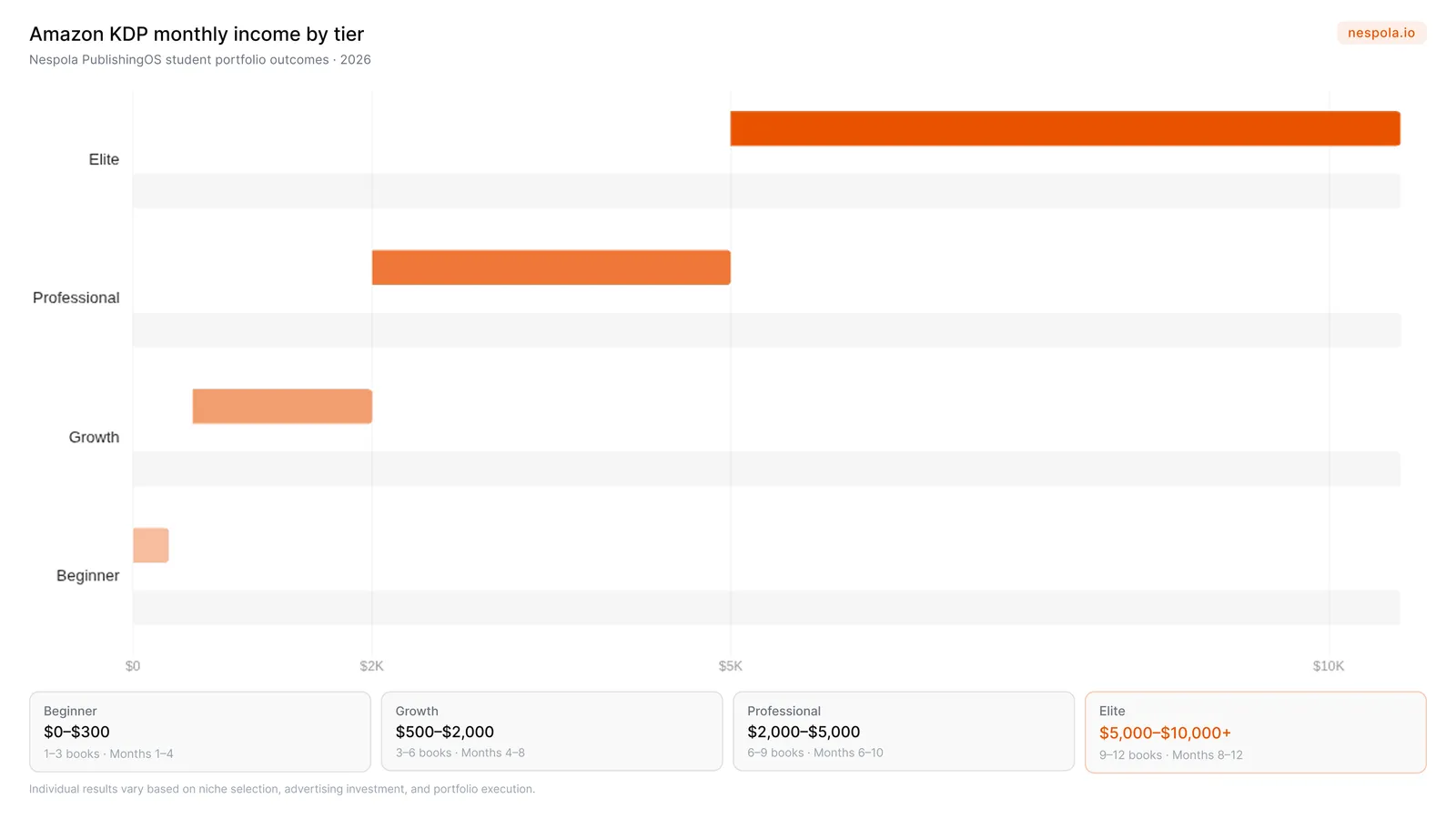
Self-published authors on Amazon KDP earn across the following ranges in 2026. These figures are drawn from Nespola's PublishingOS student portfolios — not industry averages. The outcome is determined almost entirely by strategic execution, not creative talent, writing speed, or publishing experience.
| Tier | Monthly Income | Portfolio Size | Typical Timeline | Primary Revenue Driver |
|---|---|---|---|---|
| Beginner | $0–$300 | 1–3 books | Months 1–4 | First ebook sales; reviews building |
| Growth | $500–$2,000 | 3–6 books | Months 4–8 | Paperbacks + ebooks via ads; multi-format launch |
| Professional | $2,000–$5,000 | 6–9 books | Months 6–10 | Paperbacks + hardcovers + ads + audiobooks |
| Elite | $5,000–$10,000+ | 9–12 books | Months 8–12 | Multi-format + multi-platform + translations + audiobooks |
Income ranges are based on outcomes from Nespola PublishingOS student portfolios across the Velocity, Accelerator, and Prestige programs. Individual results vary based on niche selection, advertising investment, and portfolio execution.
The single most important observation in this table: portfolio size is the primary variable separating each income tier — not writing quality, not genre, not luck. A systematic publisher who builds 12 competent, keyword-optimized non-fiction books in a validated niche will consistently outperform a gifted writer who publishes one exceptional book and waits for organic discovery.
This is the publisher mindset in practice — and it's why people with zero prior publishing experience routinely outperform career authors on this platform.
The $23/Day Benchmark: Why 12 Books Change Everything
Here is the number that drives every income projection in this guide, and the math behind it is simpler than most people expect.
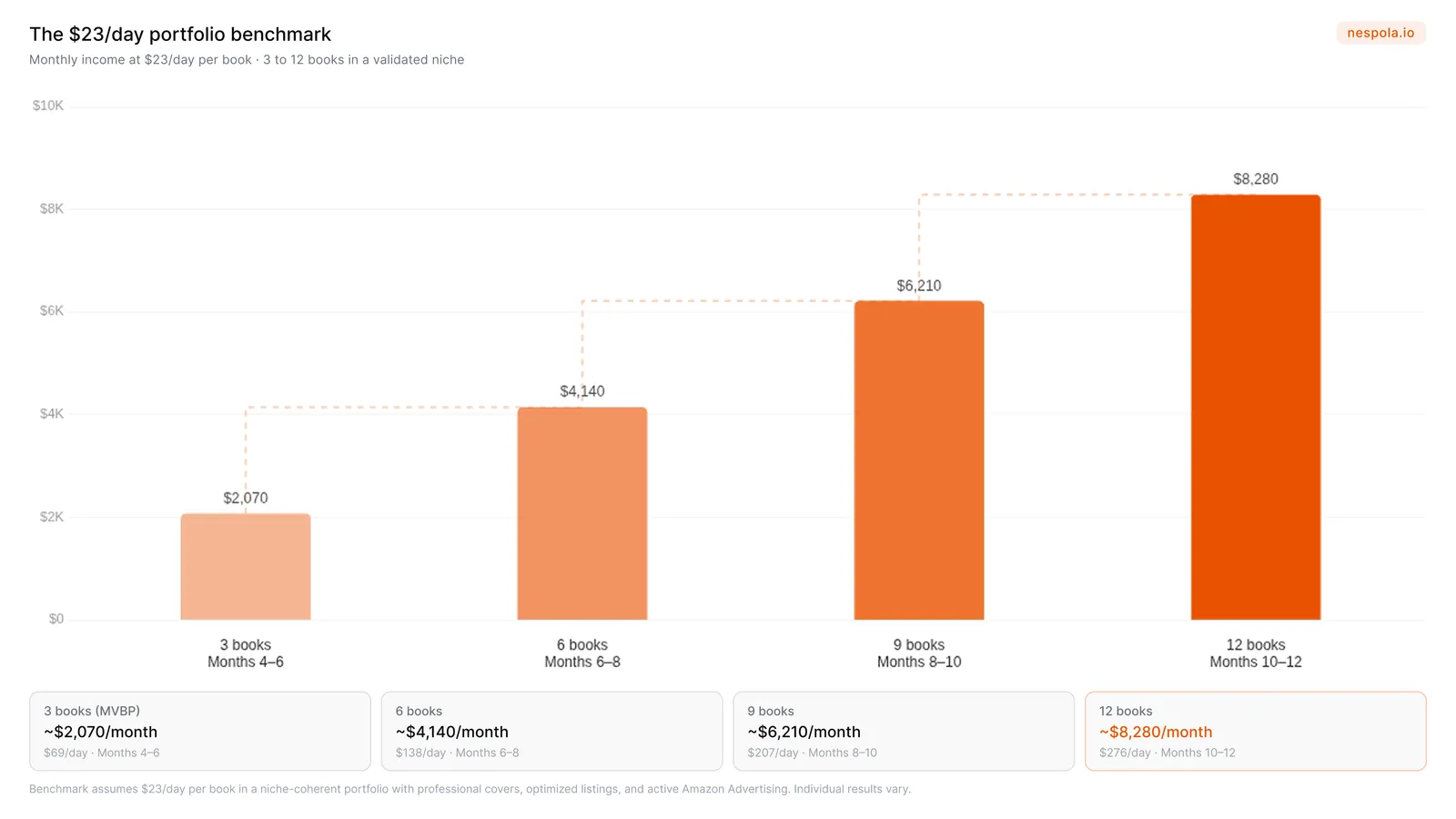
At Nespola, the $23/day benchmark is the per-book target for a systematically built, niche-coherent portfolio. A book in a validated niche, with a professional cover, keyword-optimized listing, and active Amazon Advertising, targets roughly $23/day ($690/month) in combined royalties.
The portfolio math compounds directly from there:
| Portfolio Size | Daily Target | Monthly Total | Typical Timeline |
|---|---|---|---|
| 3 books (MVBP) | $69/day | ~$2,070/month | Months 4–6 |
| 6 books | $138/day | ~$4,140/month | Months 6–8 |
| 9 books | $207/day | ~$6,210/month | Months 8–10 |
| 12 books | $276/day | ~$8,280/month | Months 10–12 |
These figures assume niche validation, professional cover design, optimized listings, and active Amazon Advertising. Individual results vary.
This is the structural logic behind why building a compounding KDP portfolio is fundamentally different from consulting, freelance, or any service income model. You build the asset once. It generates income repeatedly, and each new book added to a validated niche raises the floor for the entire catalog.
The key variable is niche selection. A portfolio of 12 books targeting the same reader in a validated niche activates Amazon's cross-promotional mechanics — "Customers Also Bought" placements, series bonuses, and catalog-level review velocity — that no single title can produce. The $23/day target is not a per-book guarantee; it is what systematic execution in the right niche makes achievable.
What Real Publishers Earn: 4 Case Studies From the Same System
The tier table above is calibrated on real outcomes. Here are the student stories behind the numbers.
Gaurav Jain — $7,800/month gross by Month 8 (Self-Help, UK)
Gaurav spent 15 years in IT before coming to KDP. His first two months were losses — $400 and $600 respectively — while ad spend built rank rather than profit. He reframed this correctly: he was buying distribution infrastructure, not burning money. Month seven was his inflection point. By December, he was clearing $4,000 in net profit in a single month. UK royalties alone have since generated $8,000 as a separate revenue stream. He works 10–12 hours per week.
Gaurav's result directly validates the 6–12-month window. His gross-to-net ratio (roughly 50% in the growth phase) is a realistic expectation for publishers running active advertising from launch.
Jason Chen — $17,000/month (Multiple niches, while in college)
Jason was studying finance and working late shifts at his family's restaurant when he built his first KDP portfolio. His finance background gave him a systematic edge: he evaluated 20 niche concepts in the time most publishers agonize over one, and approached Amazon Ads as a return-on-ad-spend optimization problem. His royalties now exceed $17,000/month from 10+ books. His result is the upper bound of what the system produces with exceptional analytical execution.
Laia Blanch & Gerard — €25,000/month (Health & Fitness, Spain → Mallorca)
Laia and Gerard came to KDP after failing at MLM and Amazon FBA. They discovered that the ebooks they were bundling for free with their FBA products were the real business. Their 24-book portfolio now generates €25,000/month in royalties. Ten of those 24 books carry the majority of revenue — one book alone generates over €1,000/month. They left Barcelona's corporate world for Mallorca and manage the business from anywhere.
Their story shows exactly what the MVBP → scale path looks like: validate the niche with 3–5 books, identify what the data confirms works, then build the catalog systematically around those winners.
Guy Olivieri — $10,000/month (Religion & Spirituality + Fiction, 49 books, New York)
Guy built his 49-book portfolio starting when the pandemic shut down his 18-year acting career in March 2020. Approximately 25% of his titles generate 80% of his income. His story represents the long-game compounding version of this business: steady, systematic publication producing a genuinely diversified income asset that funds his retirement.
How KDP Non-Fiction Publishers Actually Get Paid
For non-fiction, the revenue picture is different from what most KDP guides describe. Understanding the real income stack — what drives the majority of royalties and what plays a supporting role — is the foundation for building a portfolio with realistic expectations.
The primary driver: physical formats via Amazon Ads
For non-fiction publishers, paperbacks and hardcovers sold through Amazon ads generate the bulk of royalty income. This is not a secondary consideration — it is the engine.
The margin logic is straightforward. A $9.99 paperback with $3.00 in printing costs nets $3.00 per sale at the 60% royalty rate. A $14.99 paperback nets $6.00. A $22.99 hardcover with $7.00 printing costs nets approximately $6.79 per sale. These margins — combined with Amazon Advertising driving consistent, targetable traffic — are the core of how non-fiction income compounds.
For ebooks, the 70% royalty tier applies to prices between $2.99 and $9.99 (minus a nominal ~$0.05 delivery fee). A $6.99 ebook nets approximately $4.89 per sale. One important pricing trap to know: a $12.99 ebook at 35% royalty earns less per sale than a $9.99 ebook at 70%. Many beginners discover this only after the fact.
The format stack: where income multiplies
Every additional format a publisher launches for the same content is an independent revenue stream that requires no additional writing. The complete non-fiction income stack:
- Paperback: Primary physical format. High margin at $9.99+. Should launch alongside every ebook from day one.
- Hardcover: Premium margin, lowest price sensitivity, excellent for gift niches and reference titles. A $22.99 hardcover with $7.00 printing costs nets ~$6.79 per sale.
- Ebook: Lowest production cost, fastest to launch, primary format for digital buyers.
- Audiobook (via ACX): A distinct revenue stream reaching an entirely different audience. Production cost $200–$1,500 per title; royalty rate 25–40%. For established non-fiction titles, audiobooks routinely add 30–50% to per-title income.
- Translations: One of the highest-leverage scale moves available. German, Spanish, and French markets have strong non-fiction demand and significantly lower competition than English. AI localisation tools have made this accessible at a fraction of historical translation costs.
- Wide distribution: Publishing off KDP Select via Kobo, Apple Books, and Barnes & Noble adds incremental revenue and reduces single-platform exposure for mature titles.
A single well-optimized non-fiction title publishing across all four primary formats can generate 3–4× the income of an ebook-only title with no additional content creation. The content is identical. The format packaging is the multiplier.
Kindle Unlimited (KENP): context for non-fiction
For completeness: enrolling in KDP Select makes ebooks available to Kindle Unlimited subscribers and pays approximately $0.0040–$0.0045 per normalized page read. For non-fiction publishers, KENP typically represents around 1–5% of total revenue — meaningful but not a primary income driver. The channel is far more significant for fiction, romance, and thriller categories, where KU subscriber readership is structurally higher.
Amazon's KDP Select Global Fund paid out over $575 million in 2023 and hit $61.7 million in February 2026 alone — evidence of a platform actively investing in independent publisher viability regardless of whether KENP is the dominant driver for your specific category.
How KDP Compares to Other Income Models
KDP is one of several ways professionals build income outside a salary. The table below maps the key structural differences honestly — to help you evaluate whether this model fits your situation, not to oversell it.
| Model | Time to $1k/mo | Scales without trading more time? | Income type | Upfront capital needed | Platform dependency |
|---|---|---|---|---|---|
| Amazon KDP portfolio | 4–8 months | Yes — each book adds to the floor | Residual royalties | Low ($0–$2,000) | Medium (Amazon ecosystem) |
| Freelancing / consulting | 2–6 weeks | No — income stops when you stop | Time-for-money | None | Low |
| Amazon FBA / dropshipping | 6–18 months | Partially — inventory-constrained | Product margin | High ($5,000–$20,000+) | High (Amazon + supply chain) |
| YouTube channel | 12–36 months | Yes — but algorithm-dependent | Ad revenue | Low–Medium | Very high (Google algorithm) |
| Online course / cohort | 6–12 months | Partially — needs active launches | Digital product | Low–Medium | Low |
| Dividend investing | Years (capital-dependent) | Yes — fully passive at scale | Passive (dividends) | Very high ($100,000+) | Low |
KDP sits in a specific position: faster to income than most asset-building models, lower capital requirement than FBA or investing, and genuinely scalable in a way that service income is not. The trade-off is a 4–12-month ramp before meaningful income — which is why systematic execution in months 1–4 determines everything.
The 5 Decisions That Separate $300/Month From $3,000/Month Publishers
The income gap between KDP tiers is not talent. It is a specific set of strategic decisions made consistently at every stage. Here is what top performers do differently — and what lower-tier publishers consistently skip.
1. They validate demand before writing a single word.
High earners never commit to a manuscript without confirming that readers are actively searching for and paying for that topic. Tools like Publisher Rocket, Helium 10, and BookBeam make this quantifiable and repeatable — not an instinctive exercise.
2. They invest in professional covers without hesitation.
A professionally designed cover consistently increases conversion rates by 300–500% compared to a template-generated design — not an estimate, but measurable in split-test data. A $150 cover investment compounding across hundreds of future sales is not an expense. It is a conversion infrastructure. Every dollar saved on cover design costs more in lost lifetime revenue.
3. They run Amazon Ads as a persistent, data-driven system.
Organic discovery alone cannot sustain a growing portfolio in competitive niches. Top publishers run Amazon Sponsored Products campaigns with disciplined ACoS targets, track ad profitability per title, and reinvest consistently. Tools like Publisher Champ unify ad spend and royalty data in a single dashboard — making per-title profitability visible and manageable at portfolio scale.
4. They publish in niche clusters, not isolation.
A reader who buys Book 1 has already demonstrated purchase intent for Books 2 and 3. Publishers who build coherent Minimum Viable Book Portfolios — 3 books, one niche, one reader — multiply the lifetime value of every customer acquisition without additional marketing spend. The cross-promotional flywheel generates compounding organic revenue that no single title can produce on its own.
5. They operate like business owners, not creative hobbyists.
Publishers earning $5,000–$10,000/month track KPIs, analyze KENP trends, review per-title profitability monthly, and treat their catalog as the portfolio business it is — with reinvestment targets, performance benchmarks, and a documented publishing strategy. If your data dashboard isn't telling you which titles to optimize and which to scale, you're leaving significant income unrealized.
The Honest 12-Month Timeline
Timeline expectations matter as much as income expectations — perhaps more. Unrealistic timeline expectations cause most early-stage abandonment. Here is a realistic progression for a focused, systematic publisher:
Months 1–4 (MVBP Phase): First 3 books published in one validated niche. Revenue $0–$300/month. The primary objective isn't income — it's niche validation, process calibration, and securing initial organic reviews. You are building a proof of concept, not yet generating meaningful income. Gaurav was in negative territory during this phase and treated it as an infrastructure investment.
Months 4–8: Portfolio grows to 3–6 books. Amazon Ads are activated and beginning to optimize. Revenue reaches $500–$2,000/month. KENP trends become directionally meaningful — page-read data shows which books have genuine Kindle Unlimited readership and which niches have real compounding potential.
Months 6–10: 6–9 books in portfolio. Ad campaigns optimized. Review velocity building across the catalog. Revenue reaches $2,000–$5,000/month. The portfolio flywheel is turning — cross-promotional dynamics are visible in the data, and your top performers are clearly identified.
Months 8–12: 9–12 books across 1–2 validated niches. Revenue at $5,000–$10,000+/month. The compounding dynamic becomes self-sustaining. This is the range Gaurav ($7,800/month at month 8) represents at the Growth end, and where Jason ($17,000/month) and Laia & Gerard (€25,000/month) represent the higher end of what systematic execution produces.
Publishers who fail on KDP almost universally share one of three traits: they abandon before month 4 when income is still modest; they skip niche validation and build on unconfirmed demand; or they publish books as isolated events rather than as coordinated components of a portfolio system. Publishers who succeed share one trait: systematic consistency.
The Risk Profile Every Honest Income Guide Must Address
No legitimate guide to KDP earnings should skip the downside. Amazon has changed royalty structures, algorithm parameters, and category rules historically — and will do so again. Some niches saturate faster than expected. Some books underperform despite disciplined execution.
The structural mitigation is the portfolio architecture itself.
A 12-book portfolio across 2 validated niches carries no single point of failure. If one niche weakens, others sustain income while you analyze and adapt. If an algorithm update affects one category, the remaining portfolio continues performing while you optimize. This is the same mathematical logic that makes financial portfolio diversification superior to single-stock concentration — and it works for the same structural reasons.
Guy Olivieri's story makes this concrete: when four of his top Audible titles were hit with 50 one-star reviews overnight, his income dropped 20%. But his broader portfolio — across multiple niches and formats — absorbed the shock while he rebuilt. A single-book publisher would have lost everything. A 12-book publisher loses a percentage and keeps compounding.
Amazon also has strong incentives to maintain the indie publishing ecosystem. The KDP Select Global Fund's consistent growth trajectory reflects active platform investment in the viability of independent publishers. The broader global e-book market continues to expand — driven by rising e-reader adoption, international market growth, and a structural shift toward digital content consumption.
The Nespola PublishingOS methodology is built around portfolio-first construction precisely because it converts single-title vulnerability into a resilient, diversified asset base from the first day of production.
Frequently Asked Questions
- How much does a beginner make on Amazon KDP in their first year? In months 1–4, most publishers earn $0–$300/month while their first 3 books build reviews and advertising gets optimised. From months 4–8, a focused publisher with 3–6 books and active ads typically earns $500–$2,000/month. By months 8–12, publishers with 6–12 books in a validated niche are targeting $5,000–$10,000+/month. First-year results compound directly with how quickly you execute the MVBP and scale from it.
- Can you make a full-time income from Amazon KDP in 2026? Yes. Publishers earning $5,000–$10,000+/month are generating full-time equivalent income. Based on student outcomes, this is a realistic 6–12 month target for committed publishers with 6–12 books in a validated niche, systematic advertising, and a structured program like the Nespola Accelerator.
- How much does a single KDP book earn — and how many books do you need to make $1,000/month? A systematically built book in a validated niche with active advertising targets $23/day ($690/month) at maturity. With 3–6 books in a validated niche and active advertising, $1,000–$2,000/month is a realistic 4–8 month target. The Minimum Viable Book Portfolio of 3 books is the proof-of-concept starting point — from there, each additional book compounds the income of the ones before it.
- Is Amazon KDP income actually passive — and what is the difference between gross royalties and net profit? KDP income is best described as residual rather than passive. Creating a book requires significant upfront effort. Once published, the title generates income with minimal ongoing maintenance — but growing income at scale requires continued publishing, ad management, and periodic optimisation. As the portfolio matures and systems are built, the ratio of income to active time improves substantially. On the profit side: gross royalties are the total paid by Amazon before your expenses. Net profit is what remains after advertising spend, software tools, and production costs. In months 1–4, aggressive advertising can mean net profit is near zero — as Gaurav's experience confirms. From month 4 onward, as ads optimise, net profit margins typically run 50–70% of gross royalties.
- What is the Kindle Unlimited payout rate in 2026? The KENP rate fluctuates monthly based on the total size of the KDP Select Global Fund. In 2026, the rate is approximately $0.0040–$0.0045 per page read. For non-fiction publishers specifically, KENP typically represents around 5% of total revenue — it's a supplementary stream, not a primary one. The main income drivers in non-fiction are paperbacks and hardcovers via Amazon Ads, ebook sales, audiobooks, translations, and wide platform distribution. KENP is far more significant for fiction, romance, and thriller categories.
- Is it still worth starting Amazon KDP in 2026? The data says yes. The KDP Select Global Fund grows year-over-year. The global e-reading market continues to expand. Amazon's advertising platform has become more sophisticated, giving data-driven publishers better visibility tools than existed five years ago. Validated niches with manageable competition remain fully accessible to new entrants with disciplined execution. The window of zero-competition may have narrowed in some categories. The window of smart-execution advantage has never been wider.
- How much does Amazon take from KDP royalties? Amazon's fee is built into the royalty structure. For ebooks priced $2.99–$9.99, you keep 70%. For paperbacks at $9.99+, you keep 60% minus printing costs. These are gross royalty figures — net profit after advertising spend typically runs 50–70% of gross royalties for publishers running active ad campaigns.
- What niches earn the most on Amazon KDP in 2026? The highest-performing student niches cluster around self-help and personal development, health and fitness, business and entrepreneurship, religion and spirituality, and practical skills like investing and productivity. These categories have large Kindle Unlimited subscriber bases, strong organic search volume, and high reader appetite for sequential reading — meaning Book 1 in the niche drives natural purchases of Books 2 and 3.
- How does Amazon KDP compare to other self-publishing platforms in 2026? Amazon remains the dominant platform for independent publishers, holding over 65% of the US ebook market and the largest subscription reading audience globally through Kindle Unlimited. Competing platforms — Kobo, Apple Books, Barnes & Noble — offer meaningful supplemental revenue but rarely match Amazon's volume for non-fiction publishers. The strategic question isn't Amazon vs. alternatives; it's the KDP Select vs. wide distribution decision — one that depends on your niche, portfolio stage, and reader profile.
The publishers in this guide didn't start with publishing experience. They started with a system. The Nespola PublishingOS Accelerator is a structured 6-month program — from validated niche selection through 6 professionally published books with active advertising infrastructure and full portfolio accountability. It's the program Gaurav, Jason, Laia, and Guy used. Explore the Accelerator →
New to publishing and want to validate the model first? The Velocity Program gets your first 3 books live in 6 months — the start of your Minimum Viable Book Portfolio.