How to Find Profitable Book Niches Using AI: The Complete Framework
Learn how to find profitable book niches in 2026 using a proven 5-step AI-powered framework. The same niche validation methodology used inside Nespola's Velocity and Accelerator programs.
Quick answer: To find profitable book niches on Amazon KDP using AI, follow five steps: (1) identify broad markets with consistent buyer demand, (2) use AI to map specific sub-niches, (3) validate demand with Best Seller Rank data from tools like BookBeam, (4) assess whether the niche supports 10+ non-overlapping book concepts, and (5) run a seven-criteria checklist before committing to production. The most profitable KDP niches in 2026 have independent publishers in the top 10, multiple books earning over $700/month, and enough reader journey depth to anchor a full portfolio.
In this guide:
- What makes a book niche profitable
- Step 1: Identify broad category markets
- Step 2: Map sub-niches using AI
- Step 3: Validate demand with BSR analysis
- Step 4: Assess portfolio depth
- Step 5: The final validation checklist
- AI tools by stage
- Frequently asked questions
Knowing how to find profitable book niches is the single most important skill you can develop as a KDP publisher. Get it right, and every book you produce lands in a market that already has proven buyers. Get it wrong, and you are producing books nobody is searching for.
In 2026, AI has changed how niche research works. What used to take days of manual Amazon browsing can now be completed in hours, with far more precision. But the tools are only useful if you know what signals to look for.
This guide walks you through the exact five-step framework we use inside Nespola's Velocity and Accelerator programs to identify, validate, and lock in profitable KDP niches before we write a single word.
What Makes a Book Niche Profitable?
Before we get into the framework, here is the direct answer most people are looking for.
A profitable book niche has four characteristics:
- Consistent search demand on Amazon, measured by keyword search volume and Best Seller Rank (BSR) across multiple titles in the niche.
- Moderate competition where the top sellers are independent publishers, not major publishing houses with massive marketing budgets.
- A buying audience, meaning readers in this category purchase multiple books, not just one.
- Portfolio viability, meaning the niche can support five to ten books without cannibalizing demand from your own titles.
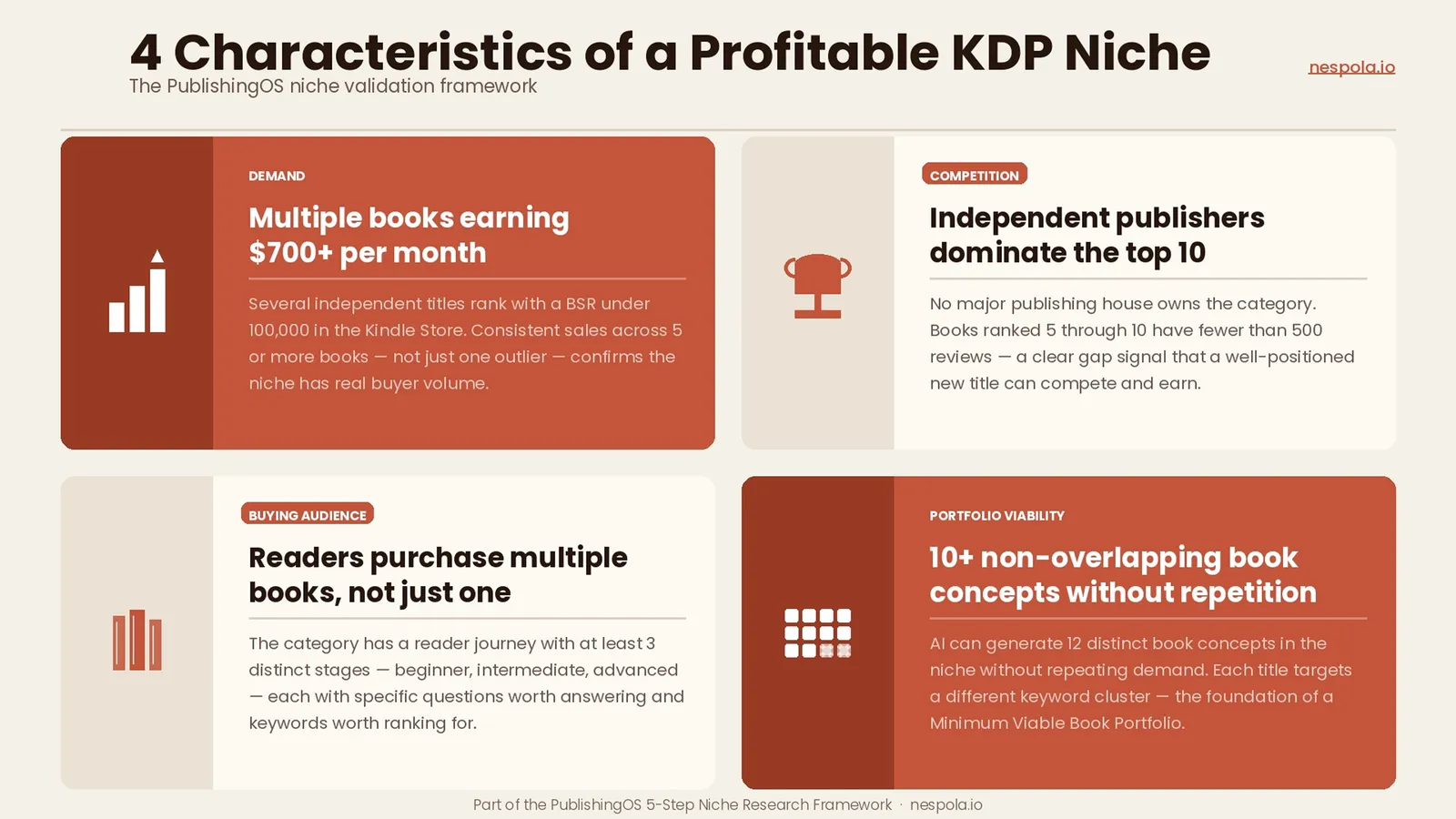
That fourth point is where most beginners go wrong. They find a niche that supports one book and stop there. The PublishingOS methodology is built around the Minimum Viable Book Portfolio (MVBP): twelve books generating an average of $700 per month each, totaling roughly $8,400 per month. That target only becomes achievable if you build inside niches deep enough to hold a portfolio.
This is also the core distinction between a publisher mindset and an author mindset. Authors optimize for one book. Publishers optimize for a niche.
Now let's walk through how to find those niches using AI.
The 5-Step AI Niche Research Framework
Step 1: Identify Broad Category Markets with Buying Intent
The starting point is not a niche. It is a market.
A market is a broad category of readers who buy books regularly: business professionals, parents of young children, people managing chronic health conditions, retirees learning new skills, and so on. These are not niches yet. They are audiences.
Your job in Step 1 is to build a list of markets that have demonstrated buying intent on Amazon KDP. The fastest way to do this is to look at what Amazon itself tells you through its category structure.
How to use AI here:
Open ChatGPT, Claude, or Gemini and prompt it with:
"Give me 20 Amazon Kindle category markets where readers are known to purchase multiple books over time. Focus on practical, non-fiction subjects. Include markets where buyers have a problem they are actively trying to solve."
From the output, filter for markets that match your own knowledge base, professional background, or genuine interest. Publishing requires producing multiple books in a niche. Working in markets where you have some familiarity significantly reduces production time and quality risk.
Output from this step: A shortlist of 5 to 10 candidate markets.
Step 2: Map Sub-Niches Within Each Market
Markets are too broad to publish into directly. You need to find the specific sub-niches where real search demand lives.
Think of it this way: "personal finance" is a market. "Budgeting for single mothers in their 30s" is a niche. The more specific your niche, the less competition you face and the more precisely you can write to a reader's exact situation.
How to use AI here:
For each candidate market from Step 1, prompt your AI tool with:
"Break down [market name] into 15 to 20 specific sub-niches that could each support a standalone non-fiction book on Amazon KDP. Focus on sub-niches with a specific audience type or life situation. Avoid overly broad or generic topics."
Then run a second prompt:
"For each sub-niche above, suggest 3 specific book titles that could realistically be published as a short-form KDP book (under 150 pages). Make the titles specific, benefit-led, and aimed at a reader who is a complete beginner."
This second pass is important. If AI cannot easily generate specific book titles in a sub-niche, that is often a signal the niche is too vague or too crowded with generic content already.
Tools for this step:
- ChatGPT or Claude for sub-niche mapping
- Google's "People Also Ask" section for real user questions inside each sub-niche
- Amazon's autocomplete bar for keyword patterns buyers actually use
Output from this step: A list of 20 to 40 specific sub-niches to investigate further.
Step 3: Validate Demand Using BSR Analysis
AI can generate niche ideas all day. Amazon's Best Seller Rank tells you whether real buyers are actually showing up.
BSR is the metric Amazon uses to rank how well a book is selling relative to every other book in its category. A low BSR number means more sales. The key for niche validation is not finding one book with a great BSR. It is finding multiple books in the same niche all performing well. That pattern tells you the demand is consistent, not a one-off outlier.
How to read BSR for niche validation:
Use a tool like BookBeam, Publisher Rocket, or Book Bolt to pull BSR data across the top 10 to 20 books in any given niche. What you are looking for:
- Multiple books with a BSR under 100,000 in the main Kindle Store (this indicates consistent daily sales)
- Top sellers include independently published titles (not major publishers)
- The number one and number two books in the niche do not have a disproportionate share of reviews compared to books at positions five through ten
That last point is the competition gap signal. If the top two books have 3,000 reviews and books three through ten have between 50 and 200, there is a real opening in the market. Buyers are purchasing from the established titles because there is nothing better yet.
The $23/day per book equation:
Inside the PublishingOS framework, we model each book targeting $23 per day in royalties, which equates to roughly $700 per month. Before committing to a niche, ask: does this niche have books currently earning at or above that threshold? If yes, the demand is real. If the top-performing books are earning less than $300 per month, the niche is likely too thin for a full portfolio.
How to use AI here:
Once you have BSR data from your research tool, bring it back into Claude or ChatGPT:
"Here is BSR data for the top 15 books in [niche name]: [paste data]. Analyze the competitive landscape. Identify whether there is a gap for a new entrant. Flag any patterns in title structure, subtitle language, or cover positioning that appear across multiple top sellers."
AI is particularly good at pattern recognition across a dataset you paste in. Use it for that, not for replacing the BSR lookup itself. For a full breakdown of how we use BookBeam and Publisher Rocket at this stage, see our guide to the best AI tools for publishing in 2026.
Output from this step: A shortlist of 5 to 8 validated niches where real sales are happening and new entrants can compete.
Step 4: Assess the Portfolio Depth of Each Niche
This step is what separates publishers from authors.
An author finds a topic and writes one book. A publisher finds a niche and asks: how many books can this niche support before demand saturates?
The answer has to be at least five, and ideally ten or more, for a niche to be worth building in. Your goal is to own a category, not occupy a slot.
How to use AI here:
For each niche on your validated shortlist, prompt:
"I am building a portfolio of non-fiction KDP books in [niche name]. Generate 12 distinct book concepts in this niche. Each book should target a different reader type, skill level, or specific sub-problem within the niche. The books should complement each other without duplicating demand."
A niche with strong portfolio depth will produce 12 distinct, non-overlapping book concepts easily. A niche that is too narrow will produce four or five ideas and then start repeating itself.
You are also checking for keyword diversity here. Each book in your portfolio should be able to rank for different keyword clusters. If all 12 concepts are competing for the same three search terms, you have a thin niche.
Secondary check:
Ask AI to map the reader journey inside the niche:
"What are the different stages a reader in [niche name] goes through, from complete beginner to advanced practitioner? At each stage, what specific questions are they trying to answer?"
If the journey has four or more distinct stages with meaningful questions at each, the niche has portfolio depth. If the journey collapses into two stages, it does not.
Output from this step: A confirmed shortlist of 2 to 3 niches with verified portfolio depth.
Step 5: Run the Final Validation Checklist Before Committing
Before you lock in your niche and begin production, run it through this final checklist. This is the same checklist we use with every student inside Velocity and Accelerator before they produce their first book.
Niche Validation Checklist
Use this checklist for each niche under serious consideration. A niche must pass all seven criteria before you move forward.
Demand Signals
- At least 5 books in this niche have a BSR under 100,000 in the main Kindle Store
- The top-performing book in the niche appears to be earning $700 or more per month based on BSR-to-sales estimates
- Amazon autocomplete returns specific, long-tail keyword suggestions when you type the niche topic into the search bar
Competition Signals
- The majority of top 10 sellers are independently published (not major publishers)
- Books ranked 5 through 10 in the niche have fewer than 500 reviews (indicating a gap you can compete into)
Portfolio Signals
- AI can generate at least 10 distinct, non-overlapping book concepts inside this niche
- The reader journey has at least 3 distinct stages with meaningful questions at each stage
If a niche passes all seven: proceed to production planning.
If a niche fails one or two criteria: investigate why and consider whether the issue is addressable (for example, a thin review count may indicate a newer niche with first-mover opportunity, not just low demand).
If a niche fails three or more criteria: move to the next candidate and do not force a weak niche.
AI Tools for Each Stage of Niche Research
| Framework Step | Primary AI Tool | Secondary Tool | What You Are Using It For |
|---|---|---|---|
| Step 1: Market identification | ChatGPT | Claude | Generating broad market ideas with buying intent |
| Step 2: Sub-niche mapping | Claude | ChatGPT | Breaking markets into specific niches and testing title viability |
| Step 3: BSR analysis | BookBeam / Publisher Rocket | Claude | Pulling real BSR data; using AI to pattern-match across results |
| Step 4: Portfolio depth | Claude | Gemini | Generating 12-book concept lists; mapping reader journey stages |
| Step 5: Final validation | Any LLM | Human judgment | Cross-checking checklist against all gathered data |
One important note on AI tools: they are research accelerators, not decision-makers. AI will generate niche ideas that sound plausible but have no real sales data behind them. Always end with the BSR check. Real buyer behavior on Amazon is the only signal that cannot be faked.
Frequently Asked Questions
- How many niches should I research before committing to one? Plan to research 20 to 30 candidate niches before committing to your first portfolio niche. Of those, roughly 5 to 10 will pass initial screening, and 2 to 3 will survive the full five-step framework. This sounds like a lot, but the research phase using AI takes far less time than it used to. A focused session of three to four hours can take you from a blank slate to a validated niche shortlist.
- Can AI find profitable niches for me automatically? Not reliably. AI is exceptional at generating ideas, mapping sub-niches, analyzing patterns in data you provide, and drafting prompts. It cannot access Amazon's live BSR data or tell you what is currently selling. The research framework works because AI handles the creative and analytical work while you use specialized tools like BookBeam or Publisher Rocket for the live sales data layer.
- What is the difference between a niche and a category on Amazon? An Amazon category is how Amazon organizes its store (for example, "Health, Fitness and Dieting"). A niche is a specific reader problem within that category (for example, "hormone health for women over 40"). Categories are useful for browsing BSR benchmarks. Your actual niche positioning happens at the book level through your title, subtitle, keywords, and description.
- How do I know if a niche is too competitive? The clearest signal of over-saturation is when the top 10 sellers are all major publishers and each has thousands of reviews. At that point, the market is proven but the entry cost in terms of production quality, marketing spend, and time to visibility is too high for an independent publisher starting a portfolio. Look for niches where the top sellers are independents and where positions 5 through 10 still have manageable review counts.
- How long does it take to validate a niche using this framework? With AI tools and a BSR research subscription, the full five-step process for one candidate niche takes approximately 45 to 90 minutes. Running the framework across 10 candidates takes a dedicated day of research. Most students in Velocity complete their niche validation inside week one of the program, using structured prompts and the research tools we provide.
- Can I publish in multiple niches at the same time? For most people starting a portfolio, the answer is no. The reason is not research capacity. It is production focus. Your first portfolio niche should reach 5 to 6 books before you consider expanding into a second niche. Building depth in one niche first produces compounding benefits: interconnected backmatter, shared brand recognition in the category, and related keywords that reinforce each other's rankings.
- Is niche research different for low-content books versus full-length non-fiction? Yes, in meaningful ways. Low-content books (journals, planners, activity books) are validated primarily through visual trends, seasonal demand patterns, and interior format differentiation rather than depth of reader journey. Full-length non-fiction relies more heavily on reader journey depth and keyword specificity. The five-step framework in this article is designed for non-fiction knowledge books, which is the core of the PublishingOS portfolio model.
What Comes Next: Building Your MVBP
Niche research is the starting gate. Once you have a validated niche, the next step is designing your Minimum Viable Book Portfolio (MVBP): the 12-book lineup that represents the foundation of your publishing business.
Each of the 12 books in your MVBP is positioned to generate an average of $700 per month, adding up to roughly $8,400 per month in total royalties. That is not a ceiling. It is the baseline we help students hit before scaling further.
The architecture of an MVBP, including how to sequence production, how to price across a portfolio, and how to use backmatter to drive cross-sales between titles, is exactly what we cover inside Velocity.
If you are ready to move from niche research into production: Apply to Velocity and work through the full PublishingOS methodology with our team alongside you.
Related Articles
- What Is PublishingOS? The Operating System Behind Nespola's Book Publishing Method
- The Best AI Tools for Writing and Publishing Books Faster in 2026
- Publisher Mindset vs. Author Mindset: How to Win on Amazon KDP
- Velocity vs. Accelerator: Which PublishingOS Program Will Scale Your Portfolio Faster?
- How to Build an Amazon KDP Portfolio for Passive Income
Tommi Pedruzzi is a co-founder of Nespola and co-creator of the PublishingOS methodology. Nespola's Velocity and Accelerator programs have helped hundreds of professionals build profitable Amazon KDP book portfolios.