What Is PublishingOS? The Operating System Behind Nespola's Book Publishing Method
PublishingOS is Nespola's methodology for building Amazon KDP books as compounding digital assets. Here's exactly what it is, how it works, and who it's built for.
When most people encounter PublishingOS for the first time, they assume it is a course. That assumption is understandable. Most things in the online education space are courses. But a course is not what we built.
A course gives you information. You watch videos, complete exercises, and absorb knowledge. What you do with that knowledge is entirely up to you. Most people do nothing with it — not because they are lazy, but because information alone does not create motion. It creates awareness. The gap between awareness and consistent action is where most publishing businesses die before they begin.
An operating system is different. An OS gives you a repeatable structure for how decisions get made, how work flows, and how outputs compound over time. Your computer does not ask you how to manage memory every time you open an app. It runs the protocol. PublishingOS works the same way: once you install the system, it tells you what to do next, how to evaluate each decision, and how to build toward a portfolio that earns money while you sleep.
That is the distinction. That is why we called it an operating system.
The problem PublishingOS solves
Most people who fail at Amazon KDP do not fail because they lack information. The internet is saturated with KDP information. They fail because they lack a system.
The typical path looks like this: someone publishes one book, waits to see if it sells, gets discouraged when it does not perform immediately, and either abandons the project or cycles through tactics without a coherent strategy. They treat each book as a standalone experiment rather than an asset in a portfolio.
The result is a single book that earns maybe $2 a day — if it earns anything at all. That is not a business. That is a hobby with an ISBN.
PublishingOS was built to solve this exact failure mode. It replaces scattered trial-and-error with a structured methodology for building a portfolio of books as compounding digital assets. Every decision — niche selection, book structure, topic targeting, pricing, cover design, scaling — is governed by the same framework, applied consistently across every title in your portfolio.
When you operate this way, books do not sit in isolation. They support each other, build authority in a niche, and compound in royalties over time. That is the architecture PublishingOS is designed to create.
What PublishingOS actually is
PublishingOS is Nespola's proprietary methodology for building Amazon KDP book portfolios as long-term digital income streams.
At its core, it rests on four principles.
- Publisher Mindset. The shift from thinking like an author to thinking like a publisher. Authors write one book and hope it sells. Publishers build catalogues, manage assets, and make systematic decisions about markets and positioning. This mindset shift is the foundation everything else is built on. We explored it in depth in our breakdown of publisher mindset vs author mindset.
- Portfolio Logic. A single book is fragile. A portfolio of 12 books in a coherent niche is a durable income asset. Portfolio Logic is the set of principles that govern how you select niches, sequence book releases, and position each title to reinforce the others. Our Minimum Viable Book Portfolio article breaks down the structural minimum needed to make the portfolio model work.
- Asset Compounding. Each book you publish earns royalties, generates reviews, and builds keyword authority on Amazon. These effects compound: later books in your portfolio benefit from the credibility established by earlier ones. Over time, a well-constructed portfolio earns more per title — not less — as it matures.
- The $23/Day Model. The financial benchmark at the center of PublishingOS. At $23 per day per book, a 12-book portfolio generates approximately $8,400 per month in passive royalties. This is not a projection — it is a target that defines the structure of the entire system. Every decision in PublishingOS is evaluated against its contribution to reaching and sustaining this benchmark.
The 4 pillars of PublishingOS
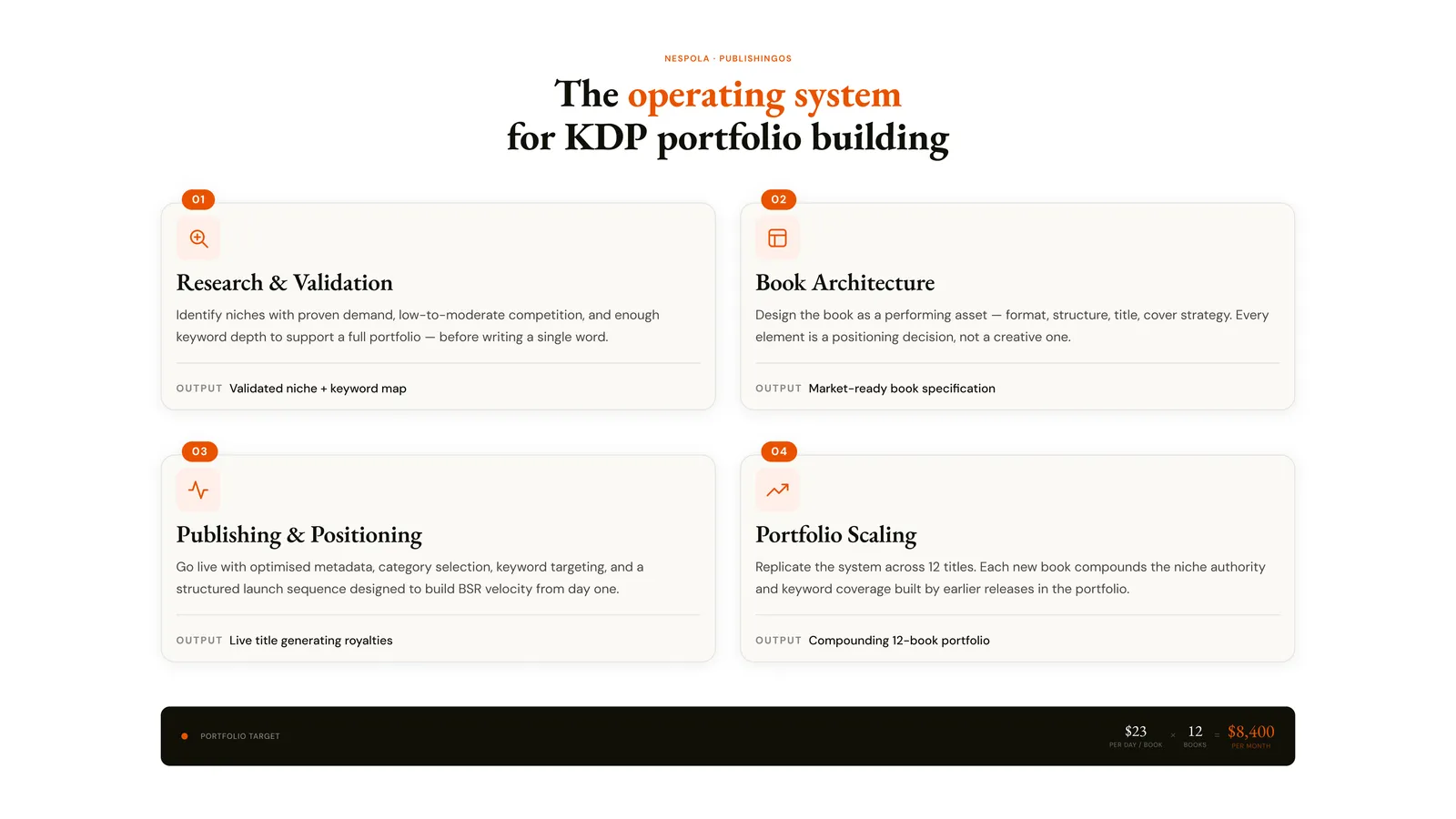
PublishingOS is structured around four sequential stages. Each stage builds on the previous one, and each is designed to produce a specific output.
Pillar 1: Research and Validation. Before writing a single word, you validate the market. This means identifying niches with proven demand, low-to-moderate competition, and enough keyword depth to support multiple titles. The tools we use for this include Bookbeam for BSR (Best Seller Rank) data and niche analysis, combined with a validation framework that filters out markets that look good on the surface but cannot support a portfolio. See our Amazon KDP niche research guide for the full process.
Pillar 2: Book Architecture. Once the niche is validated, you architect the book itself. This is not primarily about writing skill — it is about structural decisions: what type of book, how long it should be, what the cover communicates, and how the title and subtitle are constructed for search. The goal is to build a book that performs as an asset, not just as content.
Pillar 3: Publishing and Positioning. This pillar covers the mechanics of going live on Amazon KDP — metadata optimization, category selection, keyword targeting, pricing strategy, and the initial launch sequence. Most publishers treat this step as an afterthought. PublishingOS treats it as a systematic process with clear inputs and measurable outputs.
Pillar 4: Portfolio Scaling. Once the first book is live and earning, you replicate the process. The scaling pillar is where compounding begins — adding titles in sequence, reinforcing the niche, and building toward the 12-book target. This is also where you integrate what you have learned from early books to improve the quality and positioning of each subsequent release. Our guide to building an Amazon KDP portfolio covers the scaling logic in full.
What PublishingOS is NOT
Part of owning a methodology is being honest about what it does not do.
PublishingOS is not a ghostwriting service. We do have solutions to help you write your books. The methodology works because you can either bring your own domain expertise or pick an in-demand topic, learn its fundamentals, and, with PublishingOS, package and monetize that book idea.
PublishingOS is not an AI volume tool. There are services that promise to generate 50 books a month using AI with no human input. That is not what we built and not what we teach. We use AI — specifically Claude for writing and Ideogram for cover design — as a production accelerator, not as a replacement for the strategic, positioning, and validation work that actually makes books sell.
PublishingOS is not a passive income shortcut. The $23/day model requires a 12-book portfolio, which requires consistent, systematic work over 6 to 12 months. The income becomes passive once the portfolio is built around a system that requires less of your work. The building is not passive; it is methodical.
PublishingOS is not for everyone. It is not designed for people who believe they can get rich just by publishing one book quickly. It is not for fiction writers. It is not for low-content enthusiasts. It is not for people looking for a low-effort side project. If those descriptions fit, this is not the right system.
Who PublishingOS is built for
We built PublishingOS for people who want to build a second income stream that compounds over time.
The ideal PublishingOS student typically fits one of three profiles. The first is a professional who wants to exit a demanding corporate career and needs a systematic path to replace that income. The second is a high-earning professional — in finance, law, tech, health, or consulting — who recognizes that their knowledge has untapped monetization potential beyond their salary. The third is a business owner who wants to build a publishing arm that generates passive revenue alongside their existing work.
What these profiles share: they have real expertise worth packaging, they think in systems, and they are willing to execute a methodology rather than improvise their way through.
If you have knowledge in a professional field and want a systematic, compounding income asset rather than a one-book experiment, PublishingOS was designed for you.
What results look like
The benchmark we build toward is $23 per day per book. With a 12-book portfolio, that is approximately $8,400 in royalties per month.
The timeline for students in our Velocity program is 6 months. In that window, the goal is to research and validate a niche, publish the first books in a portfolio, optimize positioning and metadata, and build toward the 12-title target. Portfolio income compounds gradually rather than arriving all at once — but the structure is designed to get you there systematically.
The Velocity vs Accelerator comparison breaks down which program fits your starting point and goals. And if you want to understand where PublishingOS sits relative to other options, the Best Amazon KDP Courses 2026 article covers the landscape honestly.
You can read real accounts from students who have worked through the PublishingOS methodology in the student stories section.
How to get started
If PublishingOS sounds like the right system for where you are headed, the next step is to apply.
We review every application. We are looking for people who are excited to build a book portfolio, have realistic expectations, and are committed to executing a 6-to-12-month methodology. We do not take everyone, and we are direct about that upfront.
Frequently asked questions
- What is PublishingOS? PublishingOS is Nespola's proprietary methodology for building Amazon KDP book portfolios as compounding digital income assets. It is a structured framework — not a course — that governs every stage of the process from niche research to portfolio scaling. It was created by Tommi Pedruzzi and the Nespola founding team.
- What is the difference between PublishingOS and a KDP course? A KDP course gives you information. PublishingOS gives you a system. The difference is that a system tells you what to do next, how to evaluate each decision, and how to build toward an outcome that compounds over time. Most KDP courses deliver knowledge without a methodology for applying it consistently.
- Who created PublishingOS? PublishingOS was created by Tommi Pedruzzi, Manu Sisti, and Nic Della Pina—Nespola founding team, based in London, UK. Nespola is the company; PublishingOS is the methodology Nespola teaches inside its programs.
- How does PublishingOS work? PublishingOS works by applying a four-pillar framework — Research and Validation, Book Architecture, Publishing and Positioning, and Portfolio Scaling — to each book in a systematic portfolio. Students move through each stage in sequence, with clear inputs and outputs at every step. The result is a portfolio of Amazon KDP books that compounds in royalties over time.
- Is PublishingOS only for Amazon KDP? Yes. PublishingOS starts with Amazon KDP — Kindle Direct Publishing. The methodology is built around Amazon's platform, including its search algorithm, BSR system, metadata optimization, and royalty structure because of its predictability and longevity. Once reached a certain income per month, we do invite people to build more outside Amazon KDP with different platforms, books formats, and more modern ways to grow a diversified and profitable portfolio.