The Best AI Tools for Writing and Publishing Books Faster in 2026
The best AI tools for writing and publishing books faster in 2026, organized by stage: research, writing, cover design, and Amazon Ads. The complete KDP publisher stack.
Most self-publishers adopting AI tools in 2026 start with the writing phase and skip the research phase entirely. That is the sequence error that costs them the most. The best AI tools for writing and publishing books faster span four stages — research, writing, cover design, and advertising — and the order matters as much as the tools themselves. Search volume for AI-related publishing tools and content is growing at 38 percent year-over-year as of 2026, reflecting a structural shift in how professionals approach book production at scale.
This guide covers the complete publisher stack: which tools belong in each stage, what makes each worth the investment, and how Nespola connects them into the PublishingOS production workflow used by professionals building profitable Amazon KDP portfolios.
If you want the short version: BookBeam for research, Claude for drafting, Ideogram AI for covers, and Amazon Ads with keyword-driven campaigns for launch. The rest of this article explains why — and what to do with each one.
The Mistake That Makes Every Other Tool Irrelevant
In 2022, the question was whether AI could write a readable sentence. By 2025, that debate was over. In 2026, the question is whether self-publishers are using AI at the right stage in the right sequence — and most are not.
The pattern repeats consistently: a publisher discovers AI tools, starts generating chapter drafts immediately, publishes fast, and wonders why the books do not sell. The tool was not the problem. The sequence was.
A book written quickly but aimed at an underserved niche with no buyer demand produces exactly nothing. A cover designed without reference to genre conventions fails to convert readers who find the listing. An advertising campaign launched without a keyword strategy burns budget and yields no results.
AI does not solve a positioning problem. It amplifies whatever system sits underneath it. If that system is wrong, AI gets you to the wrong destination faster.
With that established, here is the stack worth building — in the order it should be built.
Stage 1: Research Tools
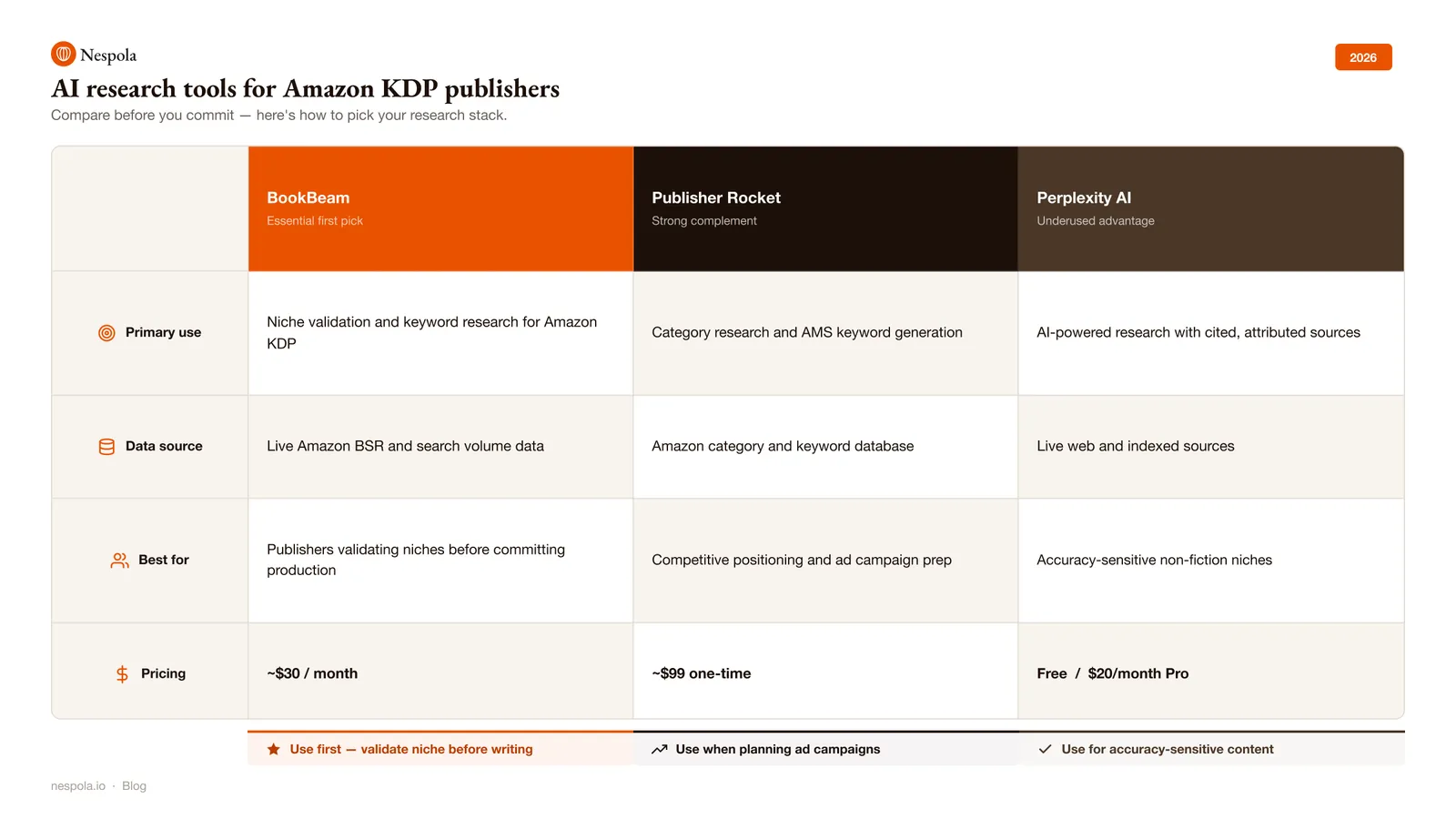
Research is where publishing income is won or lost before a single word is written. The right tool at this stage tells you whether a niche has buyer demand, how competitive it is, and which keywords will determine whether the algorithm surfaces your book to buyers. These three tools handle that in sequence.
BookBeam
BookBeam is the most purpose-built AI research platform available for Amazon KDP publishers. It translates live BSR (Best Sellers Rank) data into estimated monthly sales figures — the core validation check that determines whether a niche is worth entering before committing production resources.
The keyword research layer is equally critical. A publisher can input a broad topic and receive ranked keyword variations with estimated search volume and competition scores. Those keywords feed directly into the title, subtitle, and backend metadata of every book produced, which determines how the algorithm surfaces listings to buyers actively searching on Amazon.
BookBeam is not a nice-to-have. In the PublishingOS niche research framework, it is the first tool deployed before any other production decision is made.
Best for: Niche validation, keyword research, BSR-to-sales estimation
Pricing: Starts at approximately $30/month
Verdict: Essential — the first tool you buy
Publisher Rocket
Publisher Rocket has been a reference tool in the KDP community for years, and its AI-powered keyword and category research features have only strengthened. The core advantage for portfolio-scale publishers is its competitor intelligence layer: you can see exactly which books are selling in a given category, which keywords they rank for, and how a new title should be positioned to compete.
The AMS keyword export feature is where Publisher Rocket justifies its one-time cost. It generates ready-to-use keyword lists for Amazon advertising campaigns, which would otherwise require hours of manual research. For publishers managing ads across 10 or more titles simultaneously, that alone is the return on investment.
Best for: Category placement strategy, AMS keyword lists, competitor analysis
Pricing: One-time purchase (~$99)
Verdict: Best complement to BookBeam; essential for advertising prep
Perplexity AI
Perplexity is an AI research assistant that cites its sources. For self-publishers, that distinction matters more than it might initially seem.
Non-fiction publishers working in accuracy-sensitive niches — health, personal finance, business, law — face a consistent risk with standard AI models: the models generate plausible-sounding content that is occasionally factually wrong. Perplexity pulls from live web data and returns cited, attributed source material. That means the research pass before writing produces verified references rather than confident fabrications.
For any publisher building a portfolio in a niche where accuracy is a non-negotiable — and where a factual error could damage credibility or generate a negative review — Perplexity belongs in the workflow before Claude or ChatGPT touches the manuscript.
Best for: Topic research, cited fact-gathering, accuracy-sensitive niches
Pricing: Free tier available; Pro at $20/month
Verdict: Underused by most publishers; consistently valuable for non-fiction
Stage 2: Writing Tools
The output quality gap between major AI writing models has narrowed significantly in 2026. The competitive advantage now belongs to publishers who build the most consistent workflow around their chosen model — not those chasing the newest release.
This is worth stating plainly because the opposite belief drives a lot of counterproductive tool-switching. Publishers who change models every quarter, convinced the newest release will transform their output, produce inconsistently and learn nothing transferable. Those gaining ground are the ones who know their tools deeply.
Claude
Claude, developed by Anthropic, is the primary writing tool we recommend for non-fiction portfolio builders — and the model used inside our own content production system.
The specific advantage Claude holds for book-length content is structural coherence. When given a detailed outline, a target audience profile, and a style guide, Claude maintains logical consistency across long writing sessions that faster, more surface-level models do not. Chapters connect. Arguments build. The reader does not notice the seams.
Claude is also strong across the rewriting loop — the stage between first draft and final manuscript — which experienced publishers have learned is where the real quality gains are made. Rather than generating complete chapters from scratch in one pass, the highest-performing students in Nespola's programs use Claude in a generate-rewrite-tighten cycle: first draft produced fast, then revised against a quality bar, then tightened for clarity and flow. The output at the end of that cycle is consistently better than any one-shot generation.
Best for: Full chapter drafts, structured non-fiction, style-consistent editing
Pricing: Free tier available; Pro at $20/month
Verdict: Top pick for book writing — particularly for non-fiction at portfolio scale
ChatGPT
ChatGPT remains the most widely deployed AI writing platform in the world. For KDP publishers specifically, its value sits in a set of tasks where speed and versatility matter more than structural depth: ideation, metadata, and workflow integration.
For generating 10 book title variations in 90 seconds, drafting five Amazon book description options for split-testing, or producing back matter content for an existing title, ChatGPT outperforms Claude on speed and iteration rate. Its Custom GPT feature allows publishers to build specialized assistants trained on their style guide, niche, and brand voice — a significant productivity lever for anyone operating across multiple series or pen names simultaneously.
ChatGPT also connects to more third-party automation platforms than any other model. When you are building a publishing operation rather than writing individual books, that integration layer compounds in value.
Best for: Title and subtitle ideation, Amazon book descriptions, workflow automation
Pricing: Free tier; Plus at $20/month
Verdict: Best complement to Claude; essential for metadata and short-form tasks
Sudowrite
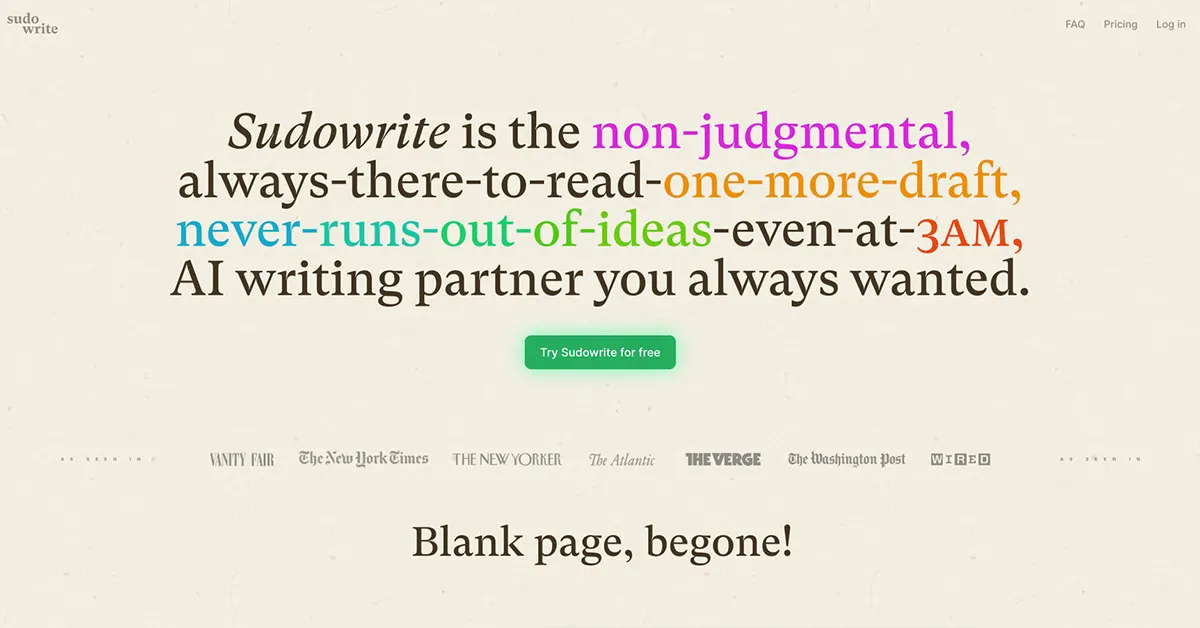
Sudowrite occupies a narrow but important position: it is the only major AI writing tool designed exclusively for fiction, and it handles narrative elements that general-purpose models approach inconsistently.
Scene pacing, character voice differentiation, plot tension — these require training data that is absent from a model built for all use cases. Sudowrite has it. For publishers building portfolios in romance, thriller, science fiction, or fantasy (all high-volume, high-repeat-purchase categories on Amazon), Sudowrite produces structurally coherent fiction drafts with a consistency that significantly reduces editing time downstream.
Non-fiction publishers can skip it. But for anyone whose portfolio is fiction-first, this is the tool that closes the quality gap between AI-assisted drafts and reader-ready manuscripts.
Best for: Fiction chapter drafts, character voice, scene development and pacing
Pricing: Starts at $19/month
Verdict: Category leader for fiction — essential if your portfolio is fiction-first
Claude + Word
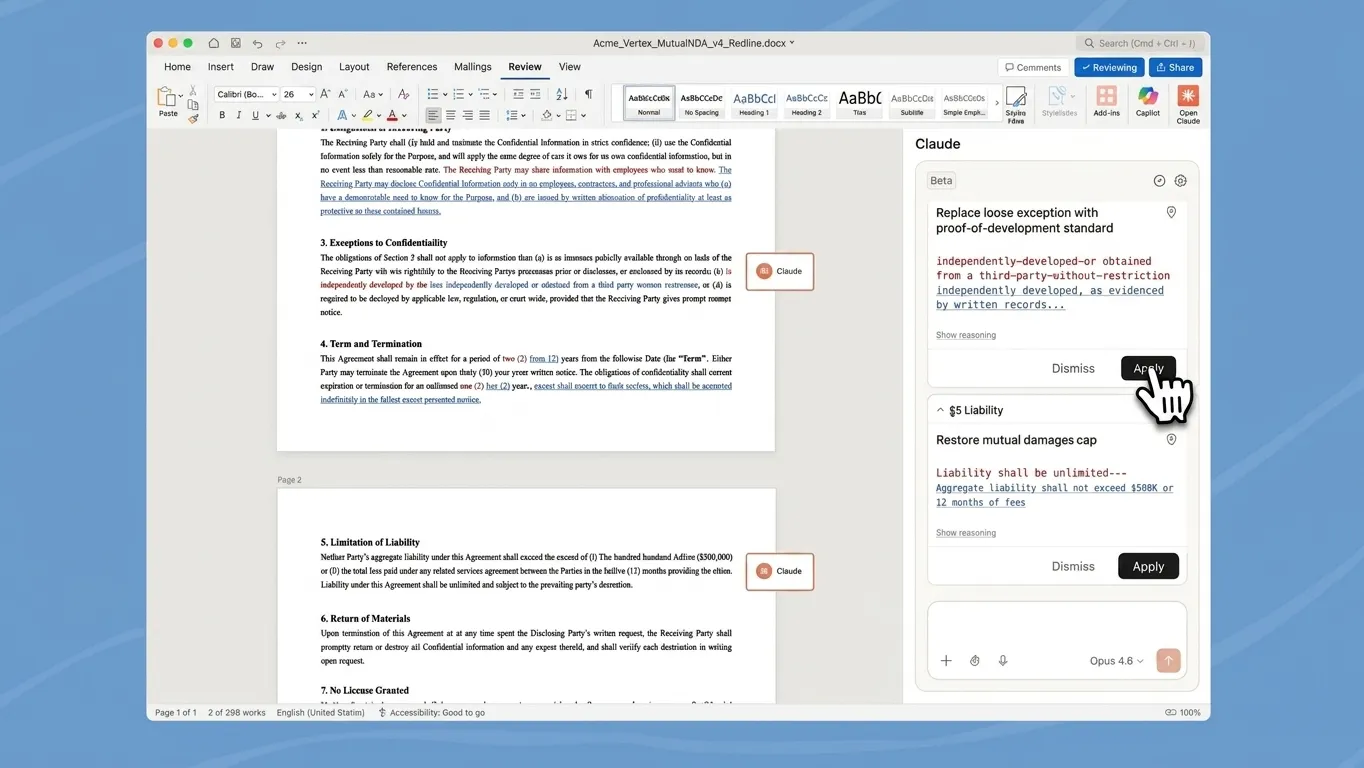
The formatting step most publishers underestimate until their first KDP upload gets rejected is not the writing — it is the interior layout. A manuscript saved as a .docx is not automatically ready for distribution. KDP's specification requirements around margins, gutter sizes, trim dimensions, heading styles, and front matter structure are precise. Files that do not meet them get rejected or produce print copies that look unprofessional.
Claude and Microsoft Word, used together, solve this without a dedicated formatting tool and with more flexibility than any fixed template library provides. The workflow is direct: Claude generates a correctly structured Word document using KDP's published specifications — minimum 0.25" margins on all sides, 0.75" gutter for print editions, mirrored page layout, correct trim dimensions, working heading hierarchy and table of contents — then exports to .docx. That file uploads cleanly to KDP without a formatter and without an additional purchase.
The practical advantage is adaptability that purpose-built tools rarely match. Switching trim sizes from 6×9 to 5.5×8.5? Reformatted in under a minute. Adding chapter ornaments or restructuring front matter for a different series? No template to fight with, no specialist required, no waiting.
For publishers building a portfolio of 12 or more titles, the cumulative time saving — and the ability to adjust specifications per title on demand — makes this the more practical production choice over a one-size template system.
Best for: Interior formatting for KDP print and ebook, trim-size adjustments, .docx export
Pricing: Claude Pro ($20/month) + Microsoft Word (included in most setups)
Verdict: More flexible than purpose-built formatters — Claude generates the spec-compliant .docx, Word exports it
Stage 3: Cover Design Tools
The book cover is a conversion mechanism before it is an aesthetic choice. It determines whether a reader scrolling a category page clicks on a listing or continues scrolling. In a category with 40 competing titles, the cover that does not immediately signal genre, quality, and reader relevance is invisible — regardless of how well-written the book inside it is.
AI has made professional-grade cover production accessible to publishers who are not trained designers. These three tools cover the full range of what most portfolios require.
Midjourney

Midjourney produces the highest-quality AI-generated imagery of any platform currently available. For genre fiction covers — romance, fantasy, thriller, horror — it generates visuals that are as specific and evocative as what premium stock photography provides, at a fraction of the cost and with far greater creative control.
A publisher who has invested time in building a library of genre-specific prompts can generate cover-ready imagery in minutes. That image is then brought into Ideogram (using its Canvas compositing feature) or Adobe Express for typography, text placement, and final composition.
The learning curve is real. Publishers who run two test images and conclude the tool does not work have not invested enough time in prompt development. Those who have spent 10 to 15 hours building genre-specific prompt libraries report a consistent and significant improvement in cover quality over stock alternatives.
Best for: Custom cover imagery, genre fiction visuals, original art direction
Pricing: Basic plan at $10/month
Verdict: Best raw image quality for fiction — pairs with Ideogram Canvas when the cover requires layered composition
Ideogram AI

Ideogram solves the problem every other AI image generator has failed to crack at production scale: text rendering. Midjourney, Stable Diffusion, and most competing platforms generate imagery beautifully but cannot reliably produce legible words inside an image. A book cover requires readable title typography embedded in the visual itself. Ideogram does this consistently — which is why it has become the primary cover tool for serious KDP publishers in 2026.
The practical implication is significant. A publisher can generate a complete cover — imagery, title text, subtitle, and author name — in a single Ideogram prompt, without a separate design tool to handle the typographic layer. The two-step workflow of generating imagery in one tool then laying text over it in another collapses into one. For non-fiction publishers especially, this removes a production bottleneck that previously required either design skills or contractor time.
The style range is extensive. Ideogram handles photorealistic imagery, painterly fiction cover aesthetics, typographic minimalism for non-fiction, and illustration styles with equal competency. Its style presets allow publishers to establish a consistent visual identity across a series without rebuilding prompts from scratch for every title. Ideogram 3.0, released in 2025, further closed the quality gap with Midjourney on raw image generation while maintaining the text rendering advantage no other tool has matched.
At $8/month for the Basic plan, it is also the most cost-efficient tool in the cover production stack.
Best for: Complete cover generation with built-in title typography, fiction and non-fiction, series consistency
Pricing: Free tier available; Basic at $8/month; Plus at $20/month
Verdict: The best AI cover tool in 2026 — generates distribution-ready covers including legible title text in a single prompt
Adobe Firefly

Adobe Firefly holds a specific advantage that the AI image generation market has not yet resolved elsewhere: its output is commercially licensed by default. Images generated inside Firefly are cleared for commercial use, which removes a legal ambiguity that persists with Midjourney and similar platforms.
For publishers who prioritize licensing clarity — or who are producing covers for a high-visibility series where legal exposure matters — Firefly's integration inside Adobe Express provides a complete design-to-export workflow without any licensing caveats.
Best for: Commercially licensed imagery, Adobe ecosystem workflows
Pricing: Included in Adobe Creative Cloud plans; limited free tier available
Verdict: Best choice when licensing clarity is the priority
Stage 4: Advertising Tools
Publishing a book on Amazon without an advertising strategy is the equivalent of launching a product with no distribution channel. The organic discovery algorithm rewards sales velocity — meaning a book that does not sell in its first 30 days rarely recovers its ranking position. AI has made campaign setup, keyword targeting, and bid management accessible to publishers without a performance marketing background.
Amazon Ads

Amazon's own advertising platform, accessed through the KDP dashboard, now includes AI-powered bid recommendations, automated targeting suggestions, and campaign performance insights built directly into the interface. For a publisher launching a first title, the automated Sponsored Products campaign is a legitimate starting point: Amazon's own AI determines targeting, adjusts bids, and surfaces performance data that informs the next campaign iteration.
Pairing Amazon's internal AI with a keyword list exported from Publisher Rocket is the foundation of what Nespola teaches across all three programs. It is not the most sophisticated advertising approach available — but it is the most accessible for professionals new to KDP advertising, and it produces measurable results in the first 30 days when executed against a validated niche.
For the full picture of how advertising integrates into portfolio-level strategy, see our breakdown of how to structure a KDP portfolio for passive income.
Best for: Direct KDP book promotion, launch campaigns, automated targeting
Pricing: Performance-based — you set the daily budget
Verdict: Non-negotiable; every title in a portfolio needs an active campaign from day one
The Nespola Publisher Stack: Connecting the Tools
All 11 tools at a glance — organized by production stage
| Stage | Tool | Primary use | Pricing |
|---|---|---|---|
| Research | BookBeam | Niche validation and keyword research | ~$30/month |
| Research | Publisher Rocket | Category research and AMS keyword lists | ~$99 one-time |
| Research | Perplexity AI | Cited topic research for non-fiction | Free / $20/month |
| Writing | Claude | Chapter drafting and structured non-fiction | Free / $20/month |
| Writing | ChatGPT | Metadata, book descriptions, automation | Free / $20/month |
| Writing | Sudowrite | Fiction drafting and narrative structure | $19/month |
| Production | Claude + Word | Interior formatting for KDP print and ebook | $20/month + Word |
| Cover | Ideogram AI | Complete cover with built-in title typography | Free / $8/month |
| Cover | Midjourney | Custom fiction imagery for complex art direction | $10/month |
| Cover | Adobe Firefly | Commercially licensed imagery | Adobe CC included |
| Advertising | Amazon Ads | KDP Sponsored Products and launch campaigns | Pay-per-click |
The publishers who outperform in 2026 are not the ones with the most tools. They are the ones who built the tightest workflow between the tools they chose.
Owning 10 separate tools without a connecting workflow produces noise, not output. Here is how these tools integrate inside the PublishingOS production system that Tommi Pedruzzi, Nic Della Pina, and Manu Sisti developed for Nespola's programs:
- Research phase: BookBeam for niche validation and keyword identification. Perplexity for topic research and cited source gathering on accuracy-sensitive content. Publisher Rocket for keyword list export to be applied in both book metadata and Amazon Ads.
- Writing phase: Claude for outline development, full chapter drafting, and rewriting passes. ChatGPT for book description variants, title testing, and back matter. Human editorial review at every handoff before the manuscript advances.
- Production phase: Claude + Word for interior formatting. Ideogram for complete cover generation including title typography. Midjourney for custom fiction imagery when creative control demands it. Adobe Firefly when licensing clarity is the priority.
- Launch and advertising phase: Amazon Ads with automated targeting to establish a baseline performance dataset. Publisher Rocket keyword lists applied to manual Sponsored Products campaigns at week two. Automated bid optimization introduced once a 30-day data baseline is established.
This is the Minimum Viable Book Portfolio production model: lean, sequenced, and designed to repeat across 12 titles without adding headcount or inflating production costs.
The same principle that separates a publisher's approach from an author's approach applies here. Authors ask which tool will help them write faster. Publishers ask which tools, in which order, will get a validated title live and selling in the shortest time. That is a different question — and it produces a different result.
What AI Tools Cannot Replace
Any honest guide to AI publishing tools includes this section.
Niche selection, audience understanding, and quality judgment are not AI problems. They are human judgment problems that require real knowledge of who is buying books in a specific category, what they need, and whether the title being built actually delivers it. A book produced at full speed by an AI-integrated workflow but aimed at a niche with no demand will not sell. An advertising campaign run through an automated platform but pointed at the wrong keywords will not return.
AI tools multiply output. They do not fix strategy.
That is precisely why Nespola structures its programs around methodology before tools. The PublishingOS approach teaches niche validation, portfolio architecture, and launch sequencing as the foundational competencies. The tool stack executes against those decisions — not in place of them.
Every tool listed in this guide will be superseded by a better version within 18 months. What does not change is the sequence: research before writing, writing before production, production before launch, launch before optimization. The publishers who understand that sequence, and who use AI to move through it faster, are the ones building portfolios that generate consistent income.
Frequently Asked Questions
- What is the best AI tool for writing a book in 2026? Claude by Anthropic is the top recommendation for structured non-fiction, based on its ability to maintain logical coherence and consistent tone across full-length manuscripts. For genre fiction, Sudowrite is the specialist option. Most experienced publishers use Claude for drafting and editing, with ChatGPT handling metadata and short-form writing tasks. The model matters less than the workflow built around it — publishers who change tools constantly outperform those who have mastered one tool's specific strengths.
- Can AI tools help me publish faster on Amazon KDP? Yes, significantly. Publishers using a well-sequenced AI workflow consistently reduce production time per book by 40 to 60 percent compared to traditional methods. The largest time savings occur at the research and first-draft stages. The gains compound across a portfolio: a publisher producing 12 titles in the time that once produced four has a structurally different income trajectory, which is the foundation of what the Minimum Viable Book Portfolio framework is built around.
- Are AI-generated books allowed on Amazon KDP? As of 2026, Amazon KDP requires disclosure when a book's content is primarily AI-generated. Books using AI as a drafting and editing aid — with substantial human authorship, review, and editorial judgment — are permitted under current guidelines. Publishers should review Amazon KDP's AI content policies directly, as these have been updated multiple times and will continue to evolve alongside the technology.
- What AI tools do professional self-publishers actually use? Professional portfolio builders working within the PublishingOS methodology use a four-stage stack: BookBeam and Publisher Rocket for research, Claude and ChatGPT for writing and metadata, Ideogram AI for complete cover generation including title typography, and Amazon Ads with supporting keyword strategy for launch. Tommi Pedruzzi, co-founder of Nespola, and the professionals across the Velocity and Accelerator programs build and scale portfolios using this system as the operational standard.
- Is there a free AI writing tool for self-publishing? Several tools in this stack have usable free tiers. Claude, ChatGPT, Perplexity, and Ideogram all offer free access with feature limitations. For publishers in the early stages of producing a first title, these free tiers are sufficient to begin. As the portfolio scales, the paid versions of research tools — BookBeam and Publisher Rocket — become the highest-return investment, because they directly determine which titles are worth producing at all. Getting that decision wrong is far more expensive than any subscription.
- How do I decide which AI tools to pay for first? Start with research tools. Poor niche selection is the single most common reason a KDP book generates no revenue, and a good research tool pays for itself with one correctly validated title. After research, prioritize formatting (Claude + Word) and writing (Claude). Cover tools and advertising tools should follow once there is a manuscript ready for production. Buying 10 tools before publishing the first title is a form of productive procrastination — avoid it.
- What is the best AI tool for Amazon book covers? Ideogram AI is the top recommendation in 2026 for both fiction and non-fiction covers. Its ability to render legible title text, subtitle, and author name directly inside the generated image removes the need for a separate design step. For genre fiction covers requiring highly specific imagery, Midjourney produces superior raw visuals that can be brought into Ideogram Canvas for the typographic layer. Adobe Firefly remains the choice when commercial licensing clarity is non-negotiable.
- Can AI tools manage Amazon Ads for book publishing? Yes. Amazon's own advertising platform includes AI-powered bid recommendations and automated Sponsored Products targeting that provide a viable starting point for publishers new to KDP advertising. Publisher Rocket supplements this with ready-to-use keyword lists. Third-party bid optimization tools add automated campaign management at portfolio scale and are typically introduced once a 30-day baseline of performance data is available. Manual oversight remains important at every stage — automated tools optimize for the signal they are given, which means the initial keyword strategy still requires human judgment.
The Best AI Tools for Publishing Books Are Only as Good as the System Behind Them
Every tool in this guide will release a better version before the year is out. The research platforms will add AI layers. The writing models will improve. The design tools will close the remaining quality gaps.
What remains constant is the method underneath them: choose the right niche, build the right title, format it correctly, launch it with an advertising strategy, and repeat. That sequence — validated and refined across thousands of titles inside Nespola's programs — is what the tools serve.
If you want to see the full methodology and connect with other professionals building KDP portfolios using this approach, the Nespola Skool community is free to join. Inside, you will find the complete KDP niche research process, the PublishingOS methodology guides, and a community of professionals operating the exact stack covered in this article.