Amazon KDP Account Banned: Why it happens, how to recover, and how to never let it happen again
KDP account banned or suspended? Learn the 5 real causes, a proven step-by-step recovery guide, and how the PublishingOS methodology keeps your portfolio protected.
There's one email no publisher want to open.
You wake up, reach for your phone (force of habit) and there it is.
An email from Amazon KDP. Subject line: "Your KDP account has been terminated."
Your stomach drops. The royalties. The books. The months of work. Gone — apparently overnight, with no warning, no phone call, and a form letter explanation vague enough to fit on a Post-it note.
Here is the part that makes it worse: you may have had no idea you were doing anything wrong.
Amazon bans thousands of KDP publisher accounts every year. Some violations are blatant. Many more are the result of honest ignorance — a keyword in a subtitle, a review service that seemed legitimate, a title that looked fine until a publishing conglomerate decided otherwise.
This article is the guide that should have existed before any of it happened. We'll cover every real cause of KDP account terminations, walk through the recovery process step by step, share a real account reinstatement story from our own community, and explain the systematic approach that publishers use at PublishingOS (by Nespola) to stay protected — not by luck, but by design.
Keep reading. This one is worth your full attention.
Part I - Why Amazon Really Bans KDP Accounts
The 5 Real Causes Behind Most Account Bans
Amazon's KDP Content Guidelines run to thousands of words. In practice, the overwhelming majority of account suspensions and terminations trace back to five root causes. Understanding each one is the first step to protecting yourself.
1. Trademark Violations: The Most Misunderstood Risk
This is the cause that catches experienced publishers off-guard most often, because the rules aren't fully written down anywhere.
Amazon does not require a formal DMCA notice or a court order to remove your books and suspend your account. If a major publisher (or even an aggressive individual) flags your content as infringing on a trademarked term, Amazon's default response is to act first and investigate later.
The confusion comes from a grey area that most publishers don't know exists: you don't have to copy anything to trigger a trademark issue. Simply using a trademarked word or phrase in your title, subtitle, or backend keywords can be enough.
Some examples that have caught publishers in our community off guard:
- ZeroPoint / Zero Point / 0 Point / No Point — all variants of WeightWatchers' trademarked ZeroPoint™ system. Using any phonetically or visually similar version in the same industry category carries real risk.
- Good Energy Cookbook — a pending trademark linked to a #1 New York Times Bestseller. Account bans have already been documented.
- Barbara O'Neill / Dr. Sebi / Dr. Now — not necessarily trademarked in every jurisdiction, but associated with authors who have large followings and enforcement ecosystems behind them. Using their names in metadata puts your account at risk.
- Cellular Health — federally trademarked. Clean topic, dangerous keyword.
- American Sign Language — a trademark exists on Sign Language itself, making books about this subject risky to publish under that exact keyword.
This is not an exhaustive list, it is a sample of why you need a live, curated resource rather than a static checklist.
IMPORTANT NOTE ON ADS: Trademarked keywords are fine to target in Amazon Ads campaigns. You are bidding for ad placement, not claiming authorship. The risk is exclusively in your book's metadata: title, subtitle, description, and the backend keywords.
2. The Global Brothers Effect: When Big Publishers Play Hardball
Not all trademark threats come from the USPTO database. Some come from aggressive enforcement by well-funded publishing operations.
Two Romanian brothers (known in the industry as the Global Brothers) have built an empire of bestselling titles under authors like Nicole Apelian and Joel Lambert, promoted heavily through Amazon and TikTok. Because they generate enormous volume for Amazon, they have disproportionate influence when they flag competitor books.
When copycat publishers started imitating their covers and keywords (phrases like "No Grid Survival Projects" and "The Lost Book of Herbal Remedies"), Global Brothers began mass-reporting accounts to Amazon. Amazon's response was blunt: suspend first, ask questions later.
The collateral damage was significant. Publishers who had simply used common keywords, without copying anyone's cover or content, found their accounts suspended simply for overlapping with metadata the Global Brothers considered their territory.
The lesson: popularity of a keyword is not protection. If a well-resourced publisher decides a keyword belongs to them, Amazon will often default to their complaint. Avoiding these territories entirely is the only safe play.
3. Manipulated Reviews: The Silent Account Killer
This is, by volume, the single most common cause of KDP account terminations.
Amazon's review integrity systems are among the most sophisticated in e-commerce. Their algorithms detect patterns that human moderators would miss: accounts created in clusters, reviews left from the same IP ranges, sudden review velocity on new titles, reviewer accounts that show no organic purchase history.
The problem isn't that publishers are malicious. The problem is that the review services market is full of providers who claim to run compliant review acquisition programs, but whose methods would fail an Amazon audit.
A service that emails 500 people and asks them to leave honest reviews sounds fine. A service that coordinates those reviews, especially when reviewers are receiving free or discounted copies without proper disclosure, enters a compliance grey zone that Amazon treats as black and white.
The risk is real enough that, at Nespola, our head of publishing personally tests every review service on our own books before recommending it to our students. The thinking is simple: if a service is going to get an account banned, it should be ours — not yours. That is not a marketing claim; it is the operational policy behind our review acquisition curriculum.
4. Title and Cover Similarity: The Copycat Trap
Amazon takes a dim view of books that appear designed to ride the coattails of established bestsellers, even when the similarity is accidental.
If your title is structurally identical to a major bestseller's title, if your cover mimics a well-known design language, or if your subtitle closely mirrors another book's positioning, Amazon may receive a complaint, and may act on it without notifying you first.
This is the violation that cost one of our community members his account. His book's title had unintentional overlap with a famous author's book. There was no copyright issue. No deliberate copying. Just a failure of due diligence at the research stage, and a ban that took months to resolve.
His story has a good ending. We'll come to that shortly.
5. Account Linking: The Rule That Trips Everyone
KDP's Terms of Service allow each person or business entity exactly one account. The intent is straightforward: prevent banned publishers from re-opening under a new name.
In practice, this rule catches innocent publishers in two common scenarios:
- Scenario A: You share a home address or Wi-Fi network with a family member who also has a KDP account. Amazon's systems detect a link, and may flag both accounts.
- Scenario B: After a suspension, you open a new account using the same device, email provider, payment method, or home address. Amazon links the new account to the old one and terminates it.
Opening a second, genuinely non-linkable account is possible, but it requires deliberate steps:
- Separate devices
- Separate IP addresses
- Separate payment methods
- Separate tax information
Done correctly, it is a legitimate recovery path. Done carelessly, it compounds the original problem.
Part II - What Happens When Your Account Gets Banned
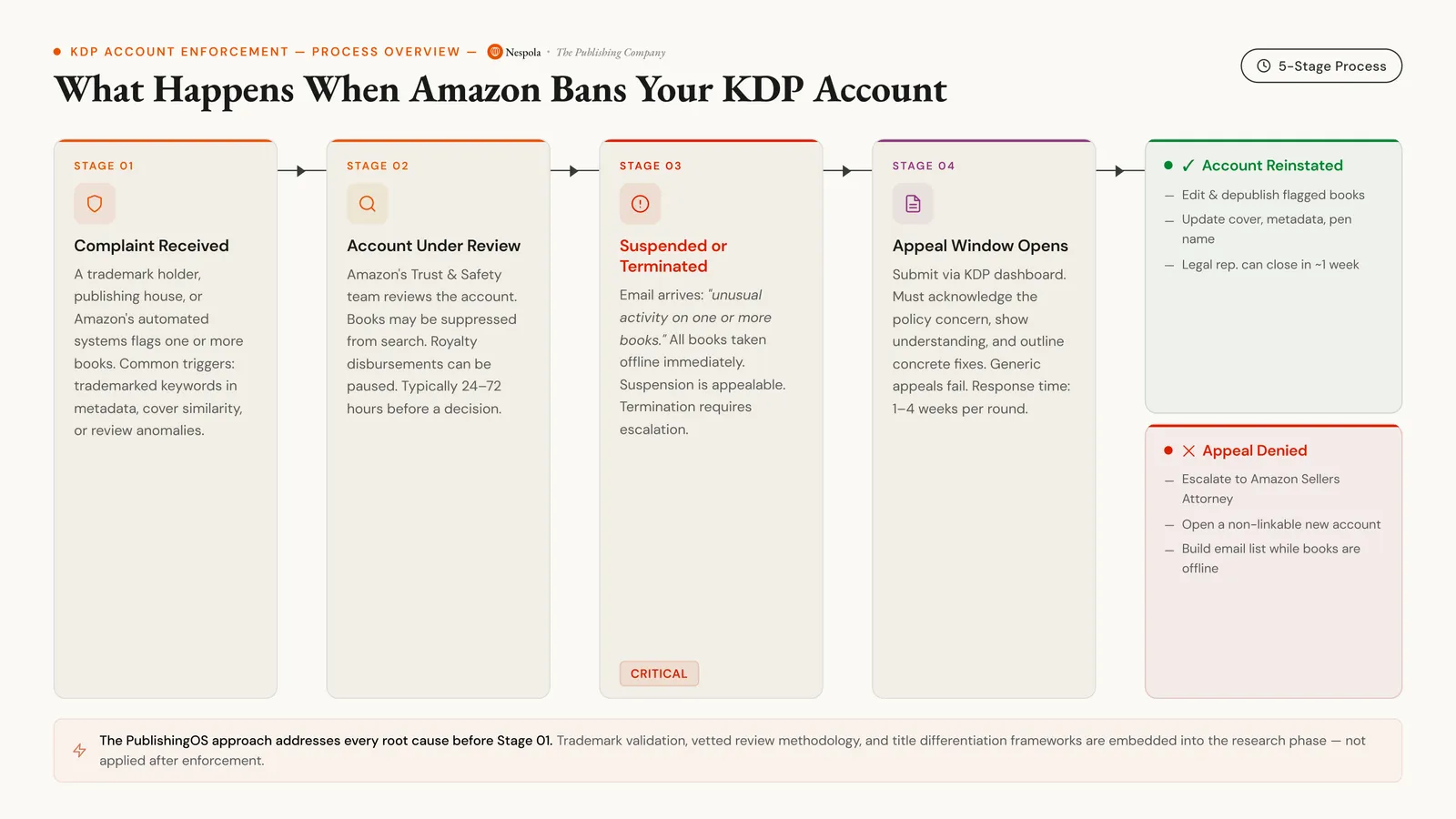
When Amazon acts against your account, the sequence typically looks like this:
- You receive an email notifying you that your account has been suspended or terminated. The language is usually generic: "unusual or suspicious activity on one or more of your books."
- Your books go offline immediately. Royalties already earned but not yet disbursed may be held.
- A review window opens. For suspensions, you typically have an opportunity to submit an appeal. For full terminations, the path back is narrower but not closed.
- Amazon's review process is not fast. Responses to appeals routinely take weeks. Multiple rounds of appeal are common.
- Reinstatement is possible, but the standard DIY appeal letter rarely works on its own for serious cases.
KDP's own account suspension resource page gives you the framework for submitting appeals. What it doesn't tell you is what actually moves the needle, and that depends heavily on the nature of the violation.
Part III - A Real Recovery Story: One Publisher's Path Back
In early 2025, Gaurav — a member of the Nespola publishing community — woke up to exactly the scenario described above. His KDP account had been banned.
The cause: unintentional similarity between his book's title and a famous author's existing title. Not a copyright issue. No bad intent. But the pattern was close enough that the affected party complained, and Amazon acted.
Here is what the recovery path looked like, in Gaurav's own words:
"It was a dreadful feeling. The Nespola team helped me in that phase and with a DIY appeal letter. I sent a couple of DIY appeals but they didn't budge. The Nespola team then suggested engaging with Amazon Sellers Attorney to pursue the attorney appeal route. I contemplated for a couple of months and then finally decided to try to clear my name. And that risk paid off."
The result: account fully reinstated, royalties paid out, within one week of the legal team's engagement.
Total investment in professional legal representation: approximately $1,500 retainer.
Gaurav's takeaways from the experience:
- Stay within the guardrails — they are there for a reason. The PublishingOS system exists precisely to keep publishers away from these edges.
- Go wide. Don't depend on a single platform. Amazon is powerful, but it is one channel. Platform risk is the cost of building a single-platform business.
The most important sentence in Gaurav's story: "This won't have been possible without the support."
Account bans feel permanent. They rarely are, if you respond correctly and quickly.
Part IV - The KDP Account Recovery Roadmap
If your account has been suspended or terminated, here is the structured response framework:
Step 1: Diagnose the Cause
Before you write a single appeal letter, you need to understand why your account was actioned. Read every notification carefully. Look at which books were flagged. Cross-reference your metadata, review history, and account activity. Guessing the cause and appealing against the wrong thing prolongs the process.
Step 2: File Your Initial Appeal
For most suspensions, you can appeal directly through your KDP account dashboard. Your appeal needs to:
- Acknowledge the issue (even if you believe it is a misunderstanding)
- Demonstrate understanding of the relevant policy
- Outline the specific changes you will make
- Avoid defensive or emotional language
Generic appeals: "I didn't do anything wrong, please reinstate my account" are almost universally unsuccessful.
Step 3: Edit and Depublish the Flagged Books
While the appeal is in progress, take action on your content. If the issue is trademark-related, make significant changes to the cover, title, subtitle, and metadata of the affected books. A new pen name may be warranted. These changes signal good faith and remove the underlying violation.
For similarity issues: change enough of the title structure, cover design, and positioning that the similarity no longer exists.
Step 4: Escalate to Legal Representation (If Needed)
If two rounds of DIY appeals fail to produce results, professional legal help becomes the most efficient path. Amazon Sellers Attorney specializes in exactly this. As Gaurav's case demonstrates, legal engagement can produce results in days that months of self-advocacy could not.
This is not a cheap option, but weigh it against the lifetime royalties of a reinstated account.
Step 5: Open a Non-Linkable New Account (If Needed)
In some cases, particularly full terminations where reinstatement is not possible, the path forward is a completely new, non-linkable KDP account. This is legitimate when done correctly, but requires:
- A new legal entity or clean personal identity
- A new device and IP address (ideally a different network entirely)
- New payment methods and tax information
- No shared identifiers with the terminated account
This step should only be taken after consulting KDP's Terms and, ideally, with guidance from someone who has navigated the process before.
Step 6: Rebuild Your Audience While Offline
If your books are temporarily offline during an appeal or editorial revision process, the time is not wasted. Lead generation through Facebook Ads, targeting the same reader demographics as your books, can build a qualified email list at $0.10–$0.30 per lead. When your revised books launch on the new account, you have a warm audience ready for reviews and day-one sales.
Part V - How PublishingOS Systematically Eliminates These Risks
The five causes above are not mysteries. They are predictable, documented patterns — which means they are preventable with the right methodology.
Here is how the PublishingOS approach addresses each one:
Trademark Risks → Guided Topic Selection
Every publisher in a Nespola program starts with keyword validation before a single word of content is written. The programs includes dedicated modules on keyword scouting, keyword anatomy, and keyword validation — a multi-step process that identifies not just demand, but safety.
This includes cross-referencing against a curated, actively maintained Keywords to Avoid file embedded in the curriculum. The file is updated as new trademark filings emerge, new enforcement patterns appear, and new complaints reach our community. It covers not just registered trademarks, but pending filings, high-risk brand-adjacent terms, and patterns associated with aggressive enforcement publishers like Global Brothers.
For additional due diligence, publishers are trained to use:
- BookBeam for marketplace trademark research (use coupon NESPOLA50)
- TM View / EUIPO for European trademark checking
- USPTO TESS for US trademark searches
Review Risks → Personally Vetted Methodology
Review acquisition is where most self-directed publishers get into trouble. The internet is full of review services with polished websites and zero compliance standards.
At Nespola, our curriculum doesn't recommend any review service that hasn't been personally tested on the team's own books first. If a service's methods carry compliance risk, it shows up in the team's account, not in a student's. This is the only standard that actually protects publishers rather than simply describing the risk.
The review acquisition modules walk through compliant approaches that generate real social proof without triggering Amazon's detection systems.
Title/Cover Similarity → Title & Metadata Frameworks
The PublishingOS curriculum includes a dedicated Title and Subtitle module that teaches structural differentiation — how to build a title that is positioned to convert without mirroring existing bestsellers. Combined with the Title Sheet (a structured tool for evaluating title risk before publication), this dramatically reduces accidental similarity.
Account Linking → Account Setup Protocol
For publishers starting fresh — or opening a second account after a previous issue — the community resource library includes detailed guidance on setting up a non-linkable KDP account with clean separation from any prior account history.
Platform Risk → Multi-Platform Strategy
This is where many "KDP education" programs stop short. PublishingOS treats platform risk as a first-class concern. The publication strategy includes distribution beyond Amazon — Ingram Spark, Draft2Digital, and eventually the publisher's own direct channel. Books are assets you own; the Amazon store is one distribution point among many.
As Nespola's head of publishing puts it:
"The first thing to understand is that, regardless of what Amazon does, the book remains your asset. You have all its components safely stored in your Google Drive — not just on the Amazon store."
Part VI - The Platform Risk Reality
Steve, another voice from our community, framed it plainly after hearing Gaurav's recovery story:
"It's good you got your account back, but what a reality check that your business can be shut down at whim. There really is no security on any platform. A business really needs to be running traffic to their own site in parallel to Amazon."
This is the uncomfortable truth that most KDP content creators avoid saying: Amazon is a marketplace, not a business. Your business is the intellectual property — the books, the brand, the audience. Amazon is where you distribute it. When you confuse the two, a platform ban feels like the end. When you understand the distinction, it is a setback with a clear path forward.
Building on Amazon is smart. Building only on Amazon is a category error.
The publishers who weather account issues fastest are those who already have an email list, a direct reader relationship, and books available on secondary platforms. They lose access to one channel. They don't lose their business.
Frequently Asked Questions
- Why did my Amazon KDP account get banned? The most common causes of KDP account bans are: (1) trademark violations — using trademarked terms in book metadata; (2) review manipulation — using services that violate Amazon's review integrity policies; (3) title or cover similarity to existing bestselling books; (4) content policy violations; and (5) account linking — operating multiple accounts tied to the same identity. Amazon typically provides vague notification language ("unusual activity"), which is why identifying the specific cause is critical before appealing.
- Can I recover a banned KDP account? Yes, in most cases a banned KDP account can be recovered, though the path depends on the cause and severity. Suspension (temporary) is more easily reversed than full termination. A well-structured appeal letter, edited/depublished flagged content, and clear evidence of policy compliance are the foundation of a successful appeal. For serious cases, professional legal representation — such as Amazon Sellers Attorney — has proven effective when self-filed appeals have failed.
- How long does a KDP account reinstatement take? Timelines vary widely. Initial appeals submitted through the KDP dashboard typically receive a response within 1–4 weeks. Multiple appeal rounds are common. When legal representation is engaged, reinstatement has been achieved in as little as one week in cases from our community. The process is rarely fast — plan for weeks, not days.
- Can I open a new KDP account if mine is banned? Opening a new KDP account after a ban is permitted only if you ensure it is genuinely non-linkable to the terminated account. This means a new device, IP address, payment method, tax information, and ideally a new legal entity or pen name. Opening a new account with shared identifiers will result in the new account being flagged and terminated as well. Detailed non-linkable account setup guidance is available within the Nespola community.
- What keywords will get my KDP account banned? Keywords that carry high ban risk include: trademarked brand names (WeightWatchers, ZeroPoint™, Cellular Health), names of authors or public figures with large enforcement ecosystems (Barbara O'Neill, Dr. Sebi, Dr. Now/Nowzaradan), titles associated with aggressive publisher enforcement (Global Brothers titles like No Grid Survival Projects and The Lost Book of Herbal Remedies), and keywords under pending trademark filings. Using these in book metadata — including backend keywords — puts your account at risk. Targeting them in Amazon Ads campaigns, however, is generally acceptable.
- Can trademarked keywords be used in Amazon Ads? Yes. Targeting trademarked keywords in Amazon Ads campaigns is different from embedding them in your book's metadata. Ad targeting is competitive placement bidding — it does not imply authorship or brand affiliation. The restriction applies specifically to your title, subtitle, book description, and the 7 backend keywords on your KDP listing.
- What is a non-linkable KDP account and do I need one? A non-linkable KDP account is a fresh account that Amazon cannot connect to a terminated account through shared identifiers (device, IP, payment method, email, address). It is needed when a terminated account cannot be reinstated through appeal. Setting one up correctly requires deliberate separation at every technical and legal level. Done incorrectly, it violates KDP's Terms of Service and compounds the original ban.
- How does the PublishingOS method protect against account bans? PublishingOS systematically addresses each major ban risk: keyword validation and trademark research are built into the book research phase; review acquisition follows a methodology personally tested by the Nespola team on their own accounts; title and metadata frameworks prevent accidental similarity to existing bestsellers; and multi-platform distribution ensures platform risk is managed at the portfolio level. Publishers following the curriculum have a structured, auditable process rather than relying on intuition.
Final Thoughts: The Business Belongs to You, Not Amazon
Amazon KDP account bans are serious. They can disrupt months of work and interrupt real income.
But they are also survivable — and, with the right methodology, largely preventable.
The publishers who end up on the wrong side of an Amazon enforcement action almost always share one thing in common: they were operating without a system. They chose keywords intuitively. They used review services without vetting them. They published first and researched second.
The publishers who avoid these problems — or recover from them quickly — operate differently. They validate before they publish. They maintain clean, documented processes. They understand that Amazon is a distribution partner, not a business foundation. And when problems arise, they solve them as entrepreneurs do: methodically, with the right people, and without panic.
If you want to build a book portfolio that generates income reliably, the system you build it on matters as much as the books themselves. That is the philosophy behind every Nespola program — and why the risk management framework is embedded from day one, not bolted on after something goes wrong.
Have questions about KDP account safety or the PublishingOS approach? Explore the Velocity program or the Accelerator program — and see exactly how the methodology works from day one through your first 90 days.