The Complete Guide to Self-Publishing on Amazon KDP (2026)
Everything you need to know about Amazon KDP: royalties, niche research, keyword strategy, portfolio building, and realistic income timelines.
Most people who discover Amazon KDP think of it as a way to publish a book. That framing is not wrong, but it is incomplete. There are book publishers who build real, sustainable income from KDP, and they do not think about it as a publishing platform. They think of it as a distribution network with one of the highest royalty rates in any media category, operating within the world's largest product search engine.
This is what this guide is built around.
Over the next 5,000 words, you will get a complete picture of how Amazon KDP actually works: how royalties are structured, how to find niches with real demand, how to move from a single book to a portfolio, and what realistic income timelines look like for people who approach this as a business.
This is the guide we wish had existed when Nespola's students started publishing. It is comprehensive by design, because the only resource worth bookmarking is one that gives you everything in one place.
1. What Is Amazon KDP?
Amazon KDP, Kindle Direct Publishing, is Amazon's self-publishing platform. It allows any author, publisher, or content creator to upload and sell eBooks, paperbacks, and hardcovers directly to Amazon's marketplace without a traditional publisher, literary agent, or minimum print run.
KDP launched in 2007 (originally as the Amazon Digital Text Platform) and has since become the dominant self-publishing channel globally. As of 2026, independent authors on KDP account for a significant share of total eBook sales on Amazon, with estimates suggesting indie titles represent more than 40% of all Kindle purchases in major non-fiction categories.
What you can publish on KDP:
- Kindle eBooks — digital books sold directly to Kindle devices and the free Kindle app on any device
- Paperbacks — print-on-demand physical books, printed and shipped by Amazon when ordered
- Hardcovers — hardcover print-on-demand, available in select markets
There is no upfront cost to publish on KDP. Amazon prints on demand and takes its margin from each sale, passing the remainder to you as a royalty. You keep the rights to your content. You can unpublish, reprice, or update your book at any time.
Why KDP matters
The case for KDP comes down to three structural advantages.
- Distribution. Amazon is where readers go to find books. With over 300 million active customer accounts globally and a search algorithm built for product discovery, KDP gives any publisher access to the same distribution shelf as traditionally published titles, regardless of size or backing.
- Royalty rates. Traditional publishing typically pays authors 10 to 15% of net sales. KDP pays up to 70% of the list price on qualifying eBooks. The structural advantage is significant, especially for portfolio publishers optimizing for monthly cash flow.
- Speed. A traditionally published book takes 12 to 18 months from manuscript to shelf. A KDP book can go from manuscript to live listing in 72 hours. For publishers moving across multiple titles, this speed advantage compounds significantly over time.
The commercial intent advantage
One of the most important things to understand about Amazon is what brings people there. On Instagram or Google, a user might be scrolling for entertainment and happen across a product. On Amazon, people arrive already in buying mode, searching for something specific to solve a specific need. That commercial intent is built into every search query on the platform, and it is a key reason why KDP works so well for non-fiction publishers targeting real reader problems.
KDP vs. traditional publishing
Traditional publishing offers prestige, editorial support, and distribution to physical retail, but it is a high-friction path for most non-fiction authors. The acceptance rate for unsolicited manuscripts is below 1%. Advances for first-time authors in non-fiction are typically $5,000 to $25,000, paid over 18 months or more. And royalties only begin after the advance is fully earned out.
KDP inverts most of this. No gatekeeper. No advance to earn out. No 18-month production cycle. And at the 70% royalty tier, the math is structurally superior for high-volume portfolio publishers.
Who KDP is for
KDP works best for non-fiction portfolio publishers: people who publish multiple books in a specific niche, treating each title as an asset that contributes to monthly recurring royalties. It works for subject matter experts, educators, and business builders who apply a systems mindset to publishing, focused on output volume, niche selection, and portfolio construction.
KDP is not the right vehicle for fiction writers chasing viral bestsellers or for anyone treating a single book as a passive-income shortcut. The platform rewards consistency, niche precision, and volume. A single well-positioned book in a strong niche might generate $200 to $600 per month. A portfolio of 15 to 20 titles in adjacent niches, built systematically, is what generates the $3,000 to $10,000 per month figures seen in real case studies.
That portfolio approach is exactly what PublishingOS, Nespola's methodology, is designed to teach and systematize.
2. How KDP Royalties Work
The royalty structure is the mechanical core of the KDP business model. Understanding it precisely, not just approximately, changes how you price, position, and scale your books.
The two royalty tiers
KDP eBooks operate on a two-tier royalty system.
70% royalty applies when all of the following are true:
- The book is priced between $2.99 and $9.99
- The book is available in all qualifying countries (or enrolled in KDP Select)
- The book is not in the public domain
35% royalty applies when:
- The book is priced below $2.99 or above $9.99
- The book is sold in a non-qualifying territory
- The conditions for the 70% tier are not met
This is not a minor difference. On a $5.99 eBook, the gap between 35% and 70% is $2.10 per sale, more than double the revenue per unit. At 100 sales per month, that is $210 per month difference on a single title. Across a portfolio of 15 titles, pricing discipline compounds significantly.
The math in practice
| Price | Royalty Tier | Revenue Per Sale | 100 Sales/Month |
|---|---|---|---|
| $0.99 | 35% | $0.35 | $35 |
| $2.99 | 70% | $2.09 | $209 |
| $4.99 | 70% | $3.49 | $349 |
| $7.99 | 70% | $5.59 | $559 |
| $9.99 | 70% | $6.99 | $699 |
| $12.99 | 35% | $4.55 | $455 |
The lesson: pricing above $9.99 almost never makes sense for eBooks. You lose the royalty tier advantage and typically see lower conversion rates. The sweet spot for most non-fiction KDP eBooks is $4.99 to $7.99.
Paperback royalties
Paperbacks operate differently. KDP pays 60% of the list price, minus the printing cost. Printing costs vary by page count, ink type (black-and-white vs. color), and market. You can calculate your exact paperback margin using Amazon's royalty calculator before setting your price.
A typical 200-page black-and-white paperback costs approximately $2.15 to print in the US. At a list price of $12.99:
- 60% of $12.99 = $7.79
- Minus $2.15 printing = $5.64 royalty per sale
Why net margin matters more than royalty percentage
Most publishers focus on royalty percentage. The number that actually determines profitability is net margin per unit: the amount deposited into your account after Amazon takes its cut and printing costs are subtracted. A $14.99 paperback with a $6.00 net margin and 80 sales per month outperforms a $4.99 eBook at 70% royalty with 100 sales per month. Tracking this metric across every title in your portfolio is what separates publishers who scale from those who plateau.
Hardcover royalties
Hardcovers follow the same 60% minus printing cost formula, with higher printing costs (typically $6 to $9 per unit). The margin is thinner, but hardcovers command higher list prices ($24.99 to $34.99 for non-fiction) and position your title as a premium product.
KDP Select and Kindle Unlimited
KDP Select is an optional 90-day exclusivity program. Enrolling means your eBook is sold exclusively through Amazon. In exchange, your book becomes available to Kindle Unlimited (KU) subscribers, Amazon's $11.99/month unlimited reading subscription.
When a KU subscriber reads your book, you earn based on pages read, measured by KENP (Kindle Edition Normalized Pages). The KENP rate fluctuates monthly but has historically sat around $0.0045 to $0.005 per page in 2026. A 200-page book fully read by a KU subscriber generates approximately $0.90 to $1.00 in royalties. In high-read-through niches, KU page reads consistently account for 30 to 50% of total monthly royalties in a mature portfolio.
The royalty insight most publishers miss
Royalties are a function of three variables: price, volume, and format. Getting all three right is what separates a $300 per month title from a $1,500 per month title on identical content. The portfolio approach, stacking eBook, paperback, and hardcover across multiple titles, is how you maximize total royalty output without writing more books.
3. How to Choose a Profitable KDP Niche
Niche selection is the highest-leverage decision in KDP publishing. You can have a well-written book, a professional cover, and precise keywords, and still fail completely if the niche has no demand or if competition makes ranking structurally impossible.
The goal is not to find a niche with no competition. The goal is to find a niche with the right level of competition: enough demand to generate consistent sales, but not so much established competition that a new title cannot break through.
The three types of KDP books and why non-fiction wins
Not all KDP books are created equal. Fiction books depend heavily on trends and reader loyalty to specific authors. Readers follow the author as much as the topic, which makes it very difficult to emerge without an established audience. Low-content books, such as journals, planners, and logbooks, are easy to produce and therefore easy to oversupply. Net margins are thin, and competition tends to race to the bottom on price.
Non-fiction is the category where the math works consistently. Readers are looking for solutions to specific problems. They are not buying because of who wrote the book. They are buying because of what the book can do for them. This removes the author's reputation as a prerequisite for success, making non-fiction accessible even to first-time publishers with no existing audience or platform.
Non-fiction is also the most predictable category. Evergreen topics such as personal finance, productivity, parenting, health, small business, and relationships have stable, year-round demand, as evidenced by decades of market data. A well-researched non-fiction title in an evergreen niche can generate royalties for years from a single production effort.
Understanding BSR
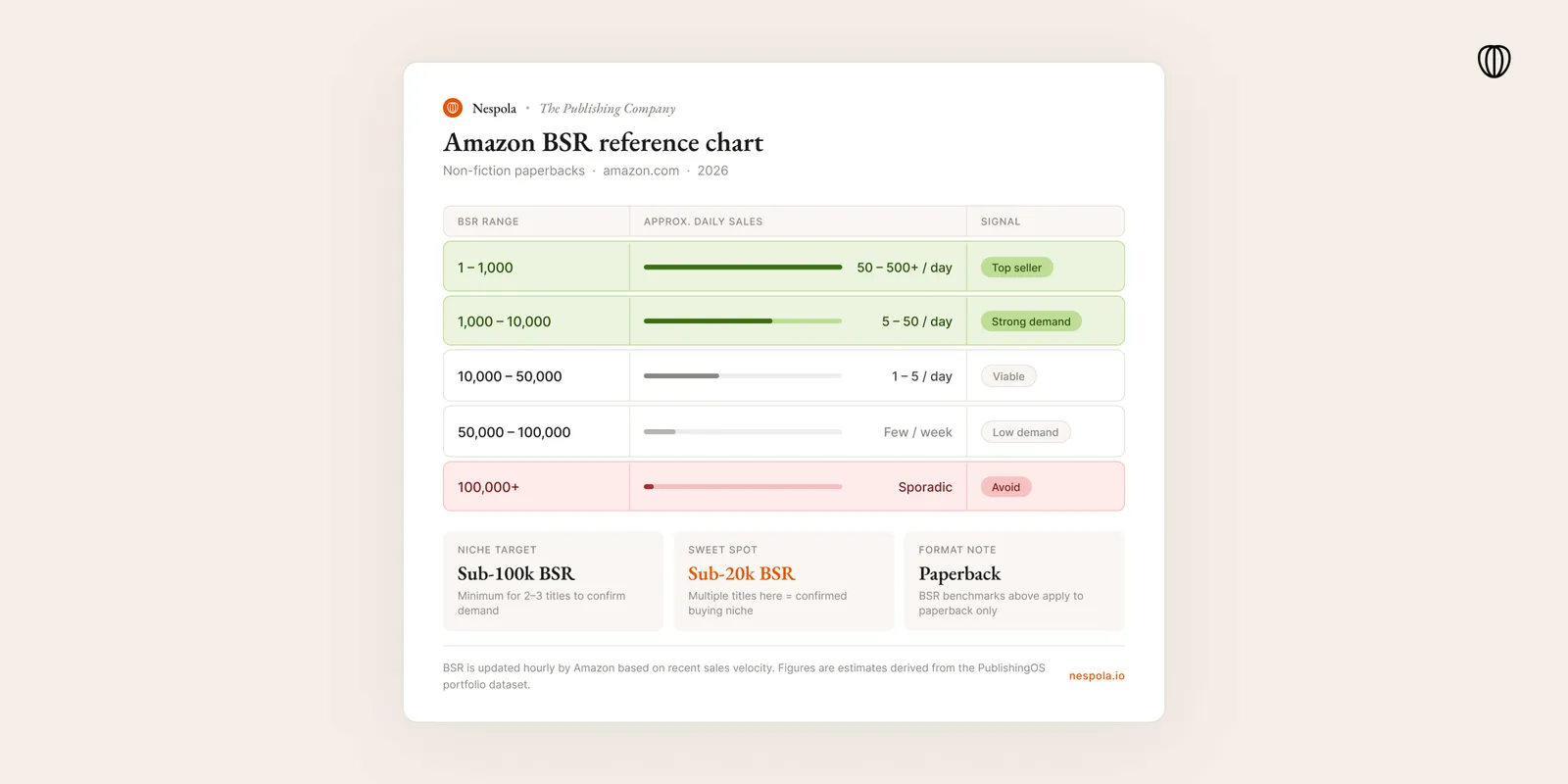
Amazon's Best Seller Rank (BSR) is the most useful demand signal available to KDP publishers. Every book on Amazon has a BSR, updated hourly, based on recent sales velocity. Lower numbers mean more recent sales.
General BSR benchmarks for non-fiction paperbacks:
| BSR Range | Approximate Sales/Day |
|---|---|
| 1 to 1,000 | 50 to 500+ |
| 1,000 to 10,000 | 5 to 50 |
| 10,000 to 50,000 | 1 to 5 |
| 50,000 to 100,000 | A few per week |
| 100,000+ | Sporadic |
You can cross-reference BSR against estimated sales using Nespola's free sales estimator — a useful tool for quickly converting a BSR number into a daily or monthly sales figure without doing manual calculations.
The PublishingOS niche framework
At Nespola, we evaluate every potential niche across two dimensions: demand signal and competition signal.
- Demand signal: Search the primary keyword on Amazon. Look at the BSR of the top results. If multiple independently published books are selling consistently, demand is confirmed.
- Competition signal: Look at the review count of the top three results. This is your barrier-to-entry indicator. Under 100 reviews on the top title means the niche is genuinely accessible to a new publisher. Over 500 reviews on the top three means you are entering an established leaderboard — possible, but slow. Learn more about the PublishingOS methodology here.
Evergreen vs. seasonal niches
Nespola students focus almost exclusively on evergreen niches. Topics with stable, year-round demand are the foundation of a predictable income. A book published into an evergreen niche this month will still be generating royalties three years from now, with more reviews and stronger ranking every month it stays live.
Seasonal niches can be added to a portfolio strategically, but they require more publishing experience to time correctly and manage. For early-stage publishers, evergreen is almost always the better first bet.
Sub-niche stacking
The most effective portfolio publishers do not just pick a niche. They systematically own a category by publishing into adjacent sub-niches. Instead of one book on "productivity," they publish books on productivity for remote workers, productivity for ADHD, productivity systems for entrepreneurs, and morning routines. Each title reinforces the others' rankings, appeals to overlapping audiences, and builds category authority on Amazon over time.
Red flags to avoid
- Niches dominated by traditional publishers or recognizable brands
- Author-driven categories where readers follow the writer, not the topic
- Niches where the top books are priced below $2.99 (a structural margin problem)
- Any niche where you cannot find at least two or three independently published books with a BSR under 100,000
4. Book Cover Design Basics
Your book cover is your primary marketing asset on Amazon. It is the first thing a reader sees in search results, before your title, before your description, before your price. On a screen where 10 to 15 books are visible simultaneously, your cover has approximately 1.5 seconds to earn a click.
The three jobs of a KDP cover
- Stops the scroll. It stands out in search results at thumbnail size, approximately 150px wide on most screens.
- Signals the genre. Readers have trained expectations for what different types of books look like. Your cover should meet those expectations, not subvert them.
- Builds trust. A professional cover communicates that the content inside is worth buying. An amateur cover signals the opposite, regardless of the actual quality of the writing.
Genre conventions matter
Non-fiction covers follow genre conventions for a reason: readers use visual cues to quickly assess whether a book is relevant to them. Business books lean toward clean, bold typography on neutral or dark backgrounds. Self-help often uses warm colors and aspirational imagery. Health and wellness tends toward natural photography or clean illustration.
Breaking genre conventions is not a differentiation strategy. It is a conversion problem. Study the top 10 to 20 books in your target category before designing your cover. Your cover should be visually distinctive within those conventions, not outside them.
The thumbnail test
Before finalizing any cover, view it at 150px wide — the size it appears in most Amazon search results on desktop. If the title is illegible, the imagery is indistinct, or the overall design is muddy at that size, it needs to be redesigned.
Typography hierarchy
Non-fiction covers follow a clear visual hierarchy: title first (largest, highest contrast), subtitle second (smaller, descriptive), author name third (smallest, typically at the bottom). Giving equal visual weight to all three creates visual chaos. Give readers one clear entry point.
Tools for KDP cover design
- Ideogram — AI image generation with strong typography support; excellent for producing professional-grade non-fiction covers efficiently
- Canva — template-based design tool; works well for covers when using premium templates rather than defaults
- Professional designers — Fiverr and 99designs both have KDP-specialized designers; budget $50 to $200 for a quality custom cover
5. Keyword Research for KDP
Keywords are the mechanism by which Amazon connects your book to a reader's search query. Getting them right determines whether your book is discoverable. Getting them wrong means your book exists on Amazon but is effectively invisible.
Two separate ranking systems
KDP operates two distinct discovery systems that most publishers conflate.
- Keywords: The search terms you enter in your 7 backend keyword slots and embed in your title and subtitle. These determine which search queries your book appears for.
- Categories: The Browse categories you select (you get 2). These determine which bestseller lists your book ranks on and where it appears when readers browse by topic.
Both matter. The category selection strategy, targeting categories where the number one bestseller has a relatively modest BSR, is how publishers earn the number one Bestseller badge legitimately. That badge appears in search results and drives meaningful click-through rate improvement.
What Amazon's algorithm responds to
Amazon's search algorithm prioritizes three things.
- Exact match: Keywords that appear verbatim in your title, subtitle, and backend slots are weighted heavily. Your primary keyword should appear in your subtitle, not just in backend fields.
- Relevance: The algorithm reads your description and uses it to assess whether your book matches the reader's search intent.
- Sales velocity and conversion rate: A book that converts clicks to purchases at a high rate will rank above a book with more keywords but fewer sales. The algorithm rewards books that readers actually buy.
Short, medium, and long-tail keywords
Short-tail keywords (one to two words, such as "vegetable gardening") have broad reach but enormous competition and are very difficult for a new publisher to rank on.
Medium-tail keywords (three to four words, such as "vegetable gardening for beginners") are less broad, more specific, and far more accessible for new publishers.
Long-tail keywords (five or more words, such as "vegetable gardening in small spaces for beginners") are highly specific, often have very low competition, and convert at high rates because the reader knows exactly what they want. Long-tail targeting is typically the right strategy for first-time publishers.
KDP keyword research workflow
- Start with 3 to 5 seed terms that describe your book's core topic
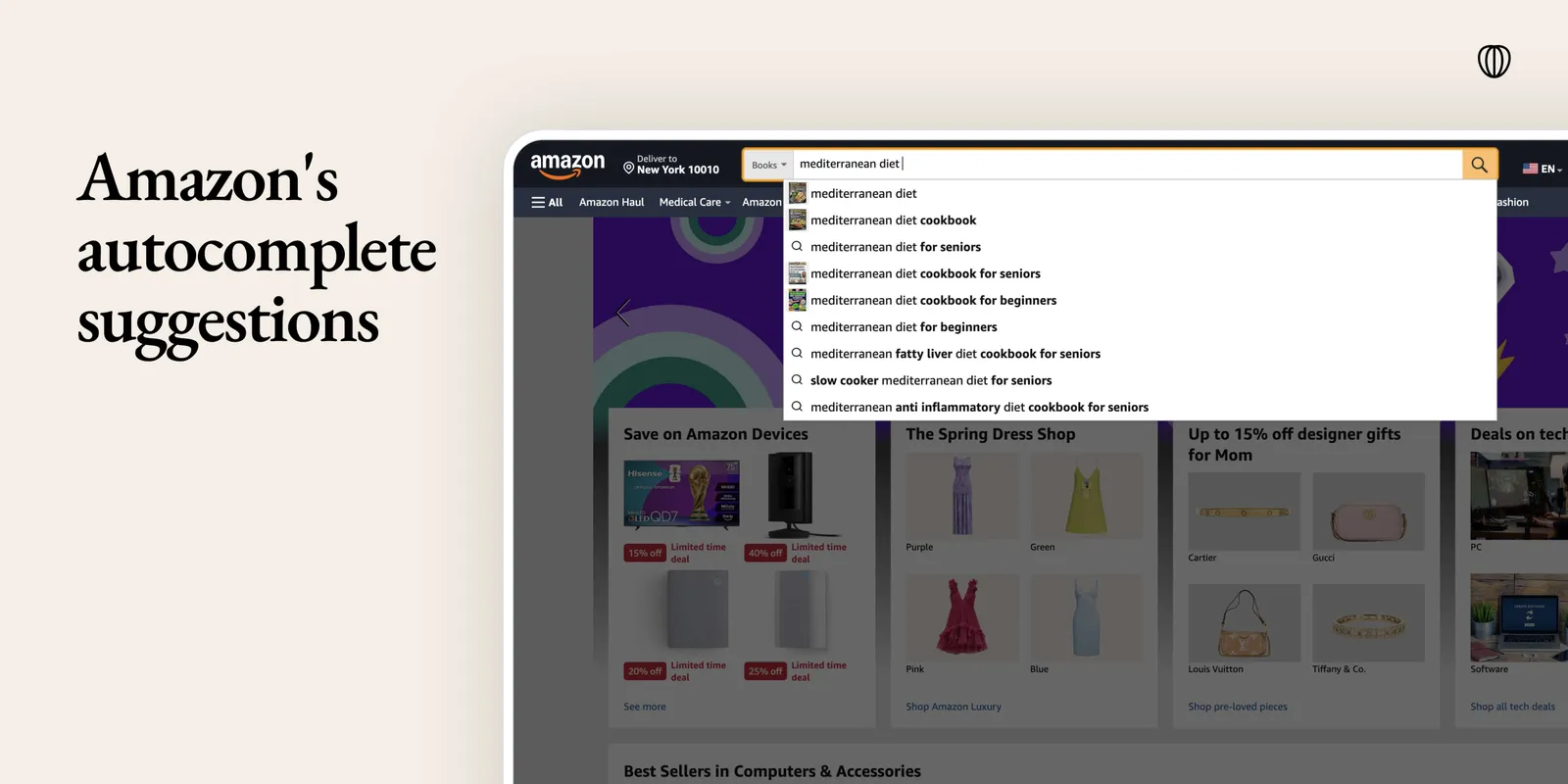
- Run each seed term through Amazon's search autocomplete — these suggestions are real queries from real readers
- For each autocomplete suggestion, note the BSR of the top results
- Flag terms where top results have BSRs under 100,000 and review counts under 150 on independently published titles
- Map winning terms to your 7 backend slots and work the primary keyword naturally into your subtitle
- Revisit and re-optimize every 90 days
Tools
- Publisher Rocket — the industry-standard KDP keyword research tool; shows estimated monthly searches and competition scores
- Bookbeam — niche research and keyword tracking; strong for BSR monitoring across a portfolio
- Amazon autocomplete — free, real-time, and often more current than any paid tool
6. How to Publish Your First Book on Amazon KDP (Step-by-Step)
Publishing your first book on KDP is a straightforward process once you know what to prepare. The following steps take you from a finished manuscript to a live Amazon listing.
Estimated time from manuscript-ready to live: 3 to 5 days, including KDP's 24 to 72-hour review window.
Step 1: Create your KDP account
Go to kdp.amazon.com and sign in with an existing Amazon account, or create a new one. Before you can publish and receive royalties, complete your tax information (W-9 for US publishers, W-8BEN for international publishers) and add your bank details. Do this before starting your first book listing to avoid a last-minute bottleneck.
Step 2: Prepare your manuscript
KDP accepts Word (.docx) and PDF files for both eBooks and print. For eBooks, a clean Word document with basic heading styles applied is sufficient for most non-fiction. Use Kindle Create (free from Amazon) for more control over the reading experience. For paperbacks, download KDP's print-ready templates sized by page count. Standard non-fiction trim sizes are 6x9 inches and 5.5x8.5 inches.
Step 3: Write your book description
Your book description is your sales page on Amazon. A high-converting non-fiction description follows this structure: a hook addressing the reader's core problem, followed by why that problem matters, what the book delivers, a bullet list of specific outcomes, and a direct call to action. Include your primary keyword naturally in the first sentence.
Step 4: Get your ISBN
KDP provides a free ISBN for paperbacks and hardcovers, sufficient for Amazon-only distribution. If you intend to distribute to other retailers, purchase your own ISBN through Bowker (US) or Nielsen (UK). A KDP-issued ISBN locks distribution to Amazon. eBooks do not require an ISBN.
Step 5: Upload your cover
Upload your cover as a JPG or TIFF file. Minimum resolution: 1,000px on the shortest side. Ideal ratio: 1.6:1 (height to width). For paperbacks, you will need a full wrap — front cover, spine, and back cover — sized precisely to your page count and trim size.
Step 6: Set your price and royalty tier
For eBooks, set your price between $2.99 and $9.99 to access the 70% royalty tier. For most non-fiction, $4.99 to $7.99 is the optimal range. Use Amazon's royalty calculator to verify your paperback margin before publishing. For paperbacks, price above KDP's minimum to generate meaningful royalties per sale.
Step 7: Choose your 2 categories
Select 2 Browse categories from KDP's list. Before selecting, check the BSR for the number-one bestseller in each category you are considering. Categories where the top book has a higher BSR are easier to earn the number one Bestseller badge in — that badge appears in search results and drives real click-through rate improvement.
Step 8: Enter your backend keywords
Use all slots. Enter full phrases rather than individual words — Amazon already indexes all individual words in your title and description, so your keyword slots add the most value when used for complete phrases your title does not already contain. Focus on long-tail variants and related queries that your target reader might search.
Step 9: Submit for review
Click "Publish Your Kindle eBook" or the equivalent for paperback. KDP reviews new submissions for content policy compliance and typically approves books within 24 to 72 hours. You will receive an email confirmation when your listing goes live.
Step 10: Your book is live
Your book is now available on Amazon. Monitor sales, page reads (if enrolled in KDP Select), and royalty estimates in real time through your KDP dashboard. Royalties are paid monthly with a 60-day delay — sales in April appear in your June payment.
7. Building a Book Portfolio (The Nespola Approach)
One book is a lottery ticket. A portfolio is a business.
This is the central insight behind PublishingOS. The difference between a publisher making $300 per month and one making $8,000 per month is rarely the quality of any individual book. It is almost always the number of income-producing assets in the portfolio, and the system used to build them.
The compounding publisher model
Each book you publish adds to your baseline monthly royalty. The relationship is approximately linear at first: each new title adds its individual contribution. As your portfolio grows, compounding effects emerge. Books in adjacent sub-niches cross-promote each other, category authority improves the ranking of the whole cluster, and KU page reads accelerate as subscribers discover one book and continue to the others.
A single well-positioned book in a strong niche might generate $400 to $800 per month. A portfolio of 15 books in related sub-niches, built systematically over 12 to 18 months, can generate $6,000 to $15,000 per month — because the books amplify each other in ways a single title cannot.
Starting with two books
A common mistake is publishing one book and waiting to see what happens before publishing the next. Publishing two or more books under the same author name or pen name from the beginning immediately compounds the advantage. Amazon's algorithm gives increasing visibility to publishers who build a consistent catalog under a single brand. Each additional title raises the ranking floor for the others, because author authority accumulates over time on the platform.
The PublishingOS portfolio phases
Phase 1: Validate (Books 1 to 3)
Publish your first two to three books in a single niche. Evaluate traction after 60 to 90 days. Which title has the strongest BSR? Which keywords are driving organic visibility? What do early readers cite in reviews as the most valuable content? Phase 1 is data collection — identifying your strongest niche signal before scaling into it.
Phase 2: Expand (Books 4 to 12)
Scale the winning niche with sub-niche variations. Add adjacent categories. Optimize titles that showed early traction with better keywords and updated descriptions. This is where monthly royalty income starts compounding meaningfully, typically the $1,000 to $5,000 per month range for publishers executing consistently.
Phase 3: Systematize (Books 12 and beyond)
Build repeatable production workflows. At this stage, the question shifts from "how do I write the next book" to "how do I maintain quality at higher output velocity?" AI tools like Claude for structuring and drafting, and Ideogram for cover generation, combined with clearly documented processes and niche disciplines, become critical enablers.
Format stacking: three ASINs from one manuscript
Every manuscript you write can generate three separate Amazon listings: eBook, paperback, and hardcover, each with its own ASIN, its own sales page, and its own contribution to monthly royalties. A reader searching for a paperback will not see your eBook listing. Format stacking ensures you capture every format preference with a single content investment.
Production velocity
Nespola students aim for 2-3 books per quarter. Using Claude for structuring and drafting, Ideogram for cover generation, and a clear content brief derived from keyword research, a 25,000 to 35,000-word non-fiction book can go from brief to manuscript in five to ten days of focused work.
Every book is a feedback loop
Every book is a work in progress, not a finished product. Books that gain visibility and sales always receive some critical reviews — that is a sign of traction, not failure. The most useful response to constructive feedback is to update the book: revise the manuscript, improve the description, and adjust the cover. Optimizing an existing book that is already indexed and accumulating reviews is almost always faster and cheaper than publishing a new one. For many publishers, the path to 3x or 5x monthly revenue runs through their existing catalog, not through adding more titles.
Series strategy
Linking books in a series — with consistent cover design, a shared author page, and internal cross-referencing between titles — increases Kindle Unlimited page read volume. A reader who finishes Book 1 and sees Books 2 and 3 in the same series has a much lower barrier to borrowing the next title.
8. Launching Your Book: Reviews and Sales Velocity
Publishing your book is not the finish line. It is the starting gun. What happens in the first 30 days after a book goes live has a disproportionate effect on its long-term ranking and revenue.
The Amazon's new release window
Amazon gives every new book a ranking boost for approximately 30 days after publication. During this window, the algorithm actively promotes new releases to help them gain initial visibility. This is your highest-leverage moment. Driving reviews and early sales velocity during this period, before the boost expires, determines whether a book climbs into a stable ranking position or fades.
Why reviews matter more than most publishers expect
Reviews do two things simultaneously. They signal quality to potential readers (higher review count and star rating drives higher click-through and conversion rates), and they signal demand to the algorithm (more reviews contribute to the ranking signals that determine where your book appears in search results).
Most books on Amazon never reach 25 reviews. Getting to 25 as quickly as possible after publication meaningfully changes a book's competitive position in its category. Reaching 100 reviews changes it dramatically.
Building sales velocity
Sales velocity, the number of copies your book sells in a short time window, is one of the key signals the algorithm uses to determine ranking. A book that sells 20 copies in three days will rank higher than one that sells 20 copies over a month. This is why launch strategy matters: concentrating early sales into a tight window gives the algorithm a strong demand signal.
The social proof tiers
- Tier 1 (first 7 to 21 days): Aim for 15 to 25 reviews, including some with photos or video if possible. Photo and video reviews are the most impactful for conversion because they let potential buyers see the physical product before purchasing. This threshold gives you enough social proof to publish the paperback and hardcover with credibility and to begin running Amazon Ads on the paperback.
- Tier 2 (days 21 to 60): Reach 100 or more reviews across all formats. At this threshold, your book appears substantially more credible in search results and becomes meaningfully easier to sell to readers encountering it for the first time.
- Tier 3 (long-term): 1,000 or more reviews positions a book as a category reference title. With a well-chosen evergreen keyword, this is achievable over one to two years for a book that is actively sold and promoted.
[BTW — if you want to know more, read how Nespola students built their first $3,000 per month from KDP.]
9. Expected Income Timelines
The most common question new KDP publishers ask is: how long until I am making real money?
The honest answer depends on niche selection, production velocity, and execution quality. But the income curve is predictable enough to give real benchmarks, informed expectations based on what Nespola students have actually experienced.
The income curve
Months 1 to 3: Foundation phase
The first three months are mostly infrastructure. You are learning the platform, validating your niche, publishing your first two to three titles, and waiting for Amazon's algorithm to index your listings and accumulate early data. Monthly royalties in this phase are typically $0 to $500. This is normal and expected.
Months 4 to 6: Traction phase
With five to eight titles published and early reviews building, organic visibility begins to compound. BSRs stabilize in stronger positions. Monthly royalties in the $500 to $2,000 range become achievable for publishers who have selected viable niches and maintained production cadence.
Months 7 to 12: Compounding phase
Publishers with 10 to 15 titles across a coherent niche cluster begin experiencing the portfolio compounding effect. Monthly royalties in the $2,000 to $6,000 range are realistic for consistent publishers with solid niche selection. KU page reads often represent 30 to 40% of total royalties by this stage.
Year 2 and beyond: Portfolio maturity
A portfolio of 20 to 30 titles in strong evergreen niches, built with keyword discipline and format stacking, can generate $5,000 to $20,000 or more per month. The income becomes largely self-sustaining once the portfolio reaches critical mass.
The $23-per-day benchmark
$23 per day is approximately $700 per month in royalties, the first meaningful income milestone for many Nespola students. At the 70% royalty tier on a $4.99 eBook, reaching this requires approximately 200 sales per month across the portfolio. With eight to ten titles generating 20 to 25 sales each, this is a realistic 6 to 9-month target for a publisher executing consistently. You can model your own numbers with Amazon's royalty calculator and Nespola's sales estimator.
What accelerates timelines
- Strong niche selection from the start (the single biggest variable)
- Consistent publication cadence of one to two books per month
- Professional covers on every title from day one
- Full format stacking at launch (eBook, paperback, and hardcover)
- Active keyword re-optimization every 90 days
- Optimizing underperforming existing titles rather than only adding new ones
What slows timelines
- Switching niches after early titles underperform, losing accumulated algorithm authority
- Publishing fewer than five titles and expecting portfolio-level income
- Amateur covers that lower conversion rates
- Not enrolling in KDP Select, leaving KU page read royalties on the table in most niches
- Treating every book as a finished, unalterable product instead of an asset to optimize
What Nespola students report
The data from our student cohorts consistently shows two patterns: students who stay in their chosen niche and maintain production cadence reach the $2,000 to $5,000 per month milestone significantly faster than those who switch niches or publish inconsistently. And students who apply the full PublishingOS methodology from day one outperform students who treat each book as an isolated project.
10. How to Get Help: Nespola Programs
KDP publishing is learnable. The platform is public, the royalty structure is transparent, and the research tools are accessible. You can figure it out independently.
But the difference between figuring it out in 24 months and figuring it out in 8 months is usually one thing: a proven methodology and a feedback loop that identifies when you are off track before you have wasted time and momentum.
That is what Nespola exists to provide.
Who Nespola is for
Our programs are built for people who want to build a publishing business, not publish a book. If you are approaching KDP as a portfolio publisher, treating each title as an asset, and are willing to apply a disciplined system, Nespola's methodology will significantly accelerate your timeline.
We are not the right fit for fiction writers, hobbyists, or people seeking a course with a guaranteed passive income.
Want to learn more about the programs we offer? You can visit the Velocity program here and the Accelerator program here.
Conclusion
Amazon KDP is a real business vehicle. The royalty structure is generous, the distribution is unmatched, and the barrier to entry is essentially zero. But those advantages mean nothing if you approach it as a single-book project rather than a portfolio business.
The shift that changes everything is not a tactic or a tool. It is a mindset: publisher, not author. An author writes a book and hopes it sells. A publisher builds a system that consistently produces assets, each of which contributes to a growing monthly royalty baseline.
Niche research, royalty math, cover standards, keyword discipline, format stacking, launch strategy, portfolio phases, income timelines: each of these is a lever. The compounding effect of pulling all of them deliberately is what separates publishers generating $300 per month from those generating $10,000+ per month on the same platform.
If you are ready to build that system with expert guidance, Nespola's programs are designed exactly for this.
The platform is there. The methodology is proven. The only variable is whether you treat it like a business.
Frequently Asked Questions
- What is Amazon KDP? Amazon Kindle Direct Publishing is Amazon's self-publishing platform that lets anyone upload and sell eBooks, paperbacks, and hardcovers directly on Amazon without a traditional publisher, paying royalties of up to 70% on qualifying eBook sales.
- How much does Amazon KDP pay in royalties? KDP pays 70% on eBooks priced between $2.99 and $9.99, and 35% outside that range. Since June 2025, paperbacks priced above $9.99 earn 60% of the list price minus printing costs; those priced at $9.99 or below earn only 50% minus printing costs.
- How long does it take to publish a book on Amazon KDP? Once your manuscript and cover are ready, KDP reviews and approves new submissions within 24 to 72 hours. The full process from a finished manuscript to a live Amazon listing typically takes 3 to 5 days.
- How many books do you need to make a full-time income on KDP? Most publishers reach $3,000–$10,000 per month with 15 to 30 books in validated evergreen niches. The $23/day benchmark — approximately $700/month per book — is achievable with a focused 3-book portfolio executing consistently across eBook, paperback, and hardcover formats.
- What is KDP Select and is it worth it? KDP Select is Amazon's optional 90-day exclusivity program. Enrolling makes your eBook available through Kindle Unlimited, earning per-page-read royalties of approximately $0.004–0.0045 per KENP page. For most non-fiction publishers, KDP Select is worth it in the first 12–18 months due to KENP income and access to promotional tools.
- What is the best niche for Amazon KDP? Evergreen non-fiction niches — personal finance, productivity, health, parenting, small business — with stable year-round demand and manageable competition consistently produce the strongest long-term royalty income. The key signal: multiple independently published books with BSR under 100,000 and under 100 reviews on the top title.
- Can I publish on Amazon KDP for free? Yes. There is no upfront cost to publish on KDP. Amazon prints paperbacks on demand and takes its margin from each sale, passing the royalty to you. The only additional costs are optional: cover design, editing, and advertising.